




The Hidden Relationship Between CRM, ERP and Marketing Automation (And What It Tells You About Your Next Deal)
Two accounts can look identical on a firmographic scorecard and still be completely different opportunities. John Britton on reading CRM, ERP and marketing automation together to find where your product actually fits.
By John Britton, VP of Marketing at Data InfoMetrix / MedicalProspects
The short answer: Industry, headcount and revenue tell you a company resembles your best customers. The CRM, ERP and marketing automation platforms it runs tell you whether your product fits, and where the integration gaps (and your deals) are. Read together, they turn a generic target list into an installed base audience you can actually sell to.
- Research links CRM value to how well it connects to the ERP, so integration gaps are buying opportunities.
- Only 29% of enterprise applications are integrated, so most stacks have room for your product.
- Add one technology criterion, such as “runs SAP ERP”, to your ICP and the list, the contacts and the message all get sharper.
A sales director once handed me two account names and asked which one we should go after first.
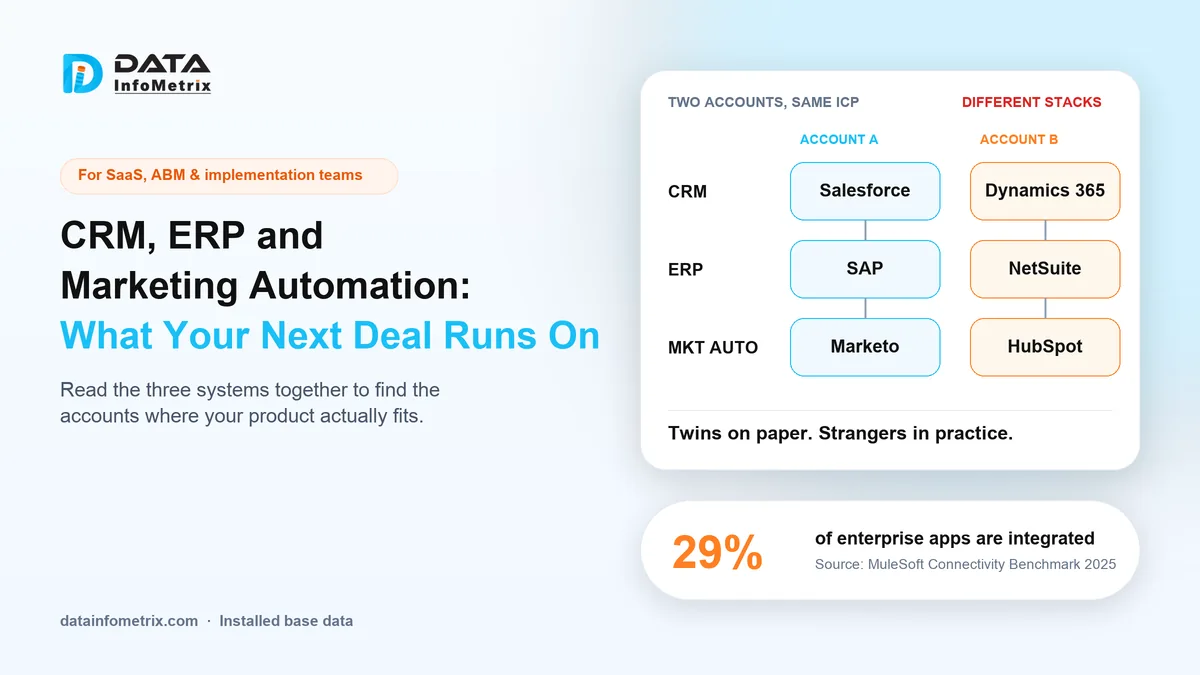
Same industry. Similar revenue. Both somewhere around 2,000 employees, both in the Midwest. On our firmographic scorecard they were practically twins, and he wanted me to break the tie.
So I looked at what they ran. The first company had Salesforce for CRM, SAP for ERP and Marketo running their campaigns. The second was on Microsoft Dynamics 365, Oracle NetSuite and HubSpot.
That settled it in about thirty seconds. We sold an integration layer built for the Salesforce and SAP world. One account was a natural fit. The other would have needed a different product, a different partner and probably a different sales team.
Twins on paper. Strangers in practice.
I think about that conversation a lot, because most B2B targeting still stops at the scorecard. Industry, headcount, revenue, geography. Those attributes tell you a company resembles your best customers. They don't tell you what the company has already built, and in technology sales that is usually the more important question. It is the same gap I described in why SAP adoption alone doesn't tell you what a manufacturer needs.
A tech stack is a map of how a company works
People talk about a company's tech stack as if it were a list of subscriptions. I see it more as a floor plan.
CRM shows you how the company manages customers and pipeline. ERP shows you how money, inventory, procurement and production move. Marketing automation shows you how demand gets created and handed to sales. Each one answers a different question. The interesting part is where they connect, because that is where the friction lives, and friction is where most of us find our deals.
There's research that backs this up, and I find it one of the more useful academic findings for anyone selling enterprise software.
According to the study Enterprise Resource Planning and Customer Relationship Management Value, published by Pedro Ruivo, Tiago Oliveira and André Mestre in Industrial Management & Data Systems in 2017, ERP turned out to be an important asset for business value, while CRM on its own showed no significant direct effect. CRM started contributing to business value when its processes were integrated with the ERP system. The data came from firms that had adopted both.
Read that again if you sell CRM. Your product's value, at least in that research, depended on how well it connected to something you probably don't sell.
That matches what I've watched happen in real accounts. When a sales team can't see order status, billing or inventory from inside the CRM, adoption drops, reps start keeping side spreadsheets, and within eighteen months somebody is asking whether the CRM was the right choice at all. The software wasn't the problem. The gap between the two systems was. And that gap is a buying opportunity for integration vendors, implementation partners, data synchronization tools and, yes, competing CRMs.
CRM isn't only a sales decision (and that changes who you target)
Most CRM campaigns I see are aimed squarely at sales leadership. VP of Sales, CRO, sales ops. It makes sense on the surface. They're the users.
The research suggests the room is bigger than that.
According to the study An Operations Management Perspective on Adopting Customer-Relations Management (CRM) Software, published by Marc J. Schniederjans, Qing Cao and Vicky Ching Gu in the International Journal of Production Research in 2012, collaboration between operations management and marketing managers during CRM acquisition was linked to better business performance. Operational reasons for adopting CRM also shaped how much performance improved.
I've lost at least one CRM-adjacent deal because I never spoke to anyone in operations. We had the sales VP excited, a strong demo, a champion who forwarded our deck around. Then the COO asked how our tool would handle their order data from the ERP. Nobody on our side had an answer ready, because nobody on our side had expected the COO to be in the conversation.
Lesson learned the expensive way. If a company runs SAP or Oracle underneath its CRM, the operations side of the house has a voice in any customer-facing technology decision. Your contact list should reflect that, and so should your buying committee map. I covered how those committees are changing in The Buying Committee Just Shrank. Your ABM Plan Didn't.
Marketing automation sits on top of everything else
Marketo, HubSpot, Account Engagement (still Pardot to most of us), ActiveCampaign. They all promise better campaigns. Every one of them is only as good as the customer data feeding it, and that data usually lives in the CRM.
When I see a company running Salesforce with Marketo, I don't just see two logos. I see a team that is probably wrestling with lead scoring, attribution, sync rules and the eternal fight over which system is the source of truth. That's a specific set of problems, and a specific set of vendors can solve them.
Now, here's where I'd add a note of caution, because it's easy to overread a stack.
According to the study Effectual and Causal Reasoning in the Adoption of Marketing Automation, published by Joel Mero, Anssi Tarkiainen and Juliana Tobon in Industrial Marketing Management in 2020, B2B companies don't adopt marketing automation through a purely planned, linear process. They mix structured decision-making with experimentation and adjustment as they go.
That rings true. I've seen two companies on the exact same marketing automation platform that could not have been more different. One had a full-time ops team, clean data and nurture programs running for years. The other bought the license during a growth spurt, built three email templates and never touched it again.
Same logo in the stack. Completely different conversation. So the platform tells you where to start, not what to say. That is also why I treat technology adoption as a buying signal rather than a verdict.
The adoption journey isn't a straight line
There's a tidy story people like to tell about how companies buy technology. CRM first. Marketing automation once marketing matures. ERP when operations get complicated.
Sometimes it happens that way. Often it doesn't.
A manufacturer usually invests in ERP long before it cares about marketing automation, because production and supply chain can't run without it. A SaaS company might run HubSpot and Salesforce for years on top of a bare-bones finance system. And plenty of companies with a decades-old ERP are shopping for their second or third CRM.
How many of your current campaigns assume a buying sequence your prospects never followed?
The research on outcomes makes the same point from another angle. According to the study The Impact of Enterprise Systems on Corporate Performance: A Study of ERP, SCM, and CRM System Implementations, published by Kevin B. Hendricks, Vinod R. Singhal and Jeff K. Stratman in the Journal of Operations Management in 2007, which looked at 186 ERP, 140 supply chain management and 80 CRM implementation announcements, results varied widely by system. ERP adopters showed some profitability gains (stronger for early adopters) but no improvement in stock returns. Supply chain systems showed gains on both. CRM showed no clear improvement on either.
I don't share that to knock CRM. I share it because it kills a lazy assumption I hear constantly in planning meetings: that a company using a big enterprise platform is mature, successful and therefore ready to buy more.
Not necessarily. A company's stack tells you what it runs. It doesn't tell you whether things are going well, whether a replacement is on the table, or whether the integration is held together with duct tape. You find that out through research and conversation. The stack just tells you which conversation to have first.
Most stacks are far less connected than buyers admit
One more number, because it explains why so many of these opportunities exist in the first place.
According to the 2025 Connectivity Benchmark Report from MuleSoft, produced with Vanson Bourne and Deloitte Digital from a survey of more than 1,050 IT leaders, the average enterprise now runs 897 applications, and only 29% of them are integrated. Just 2% of organizations reported having more than half their applications connected.
Twenty-nine percent. Every time I quote that figure in a client workshop, someone in the room laughs a little too knowingly.
That gap between the CRM, the ERP and the marketing platform isn't an edge case. It's the normal state of most enterprises. If your product, service or practice lives in that gap, your market is much bigger than a firmographic list will ever show you.
Where the stack points to real pipeline
So what do you actually do with this? Here's how I'd think about it depending on what you sell.
If you sell a competing platform, the installed base is your conquest list. A Salesforce alternative should be talking to Salesforce users, not to companies with no CRM at all. But usage alone doesn't prove anyone wants to switch. Pair it with timing signals like contract cycles, leadership changes or a migration announcement before you assume intent. We go deeper on that in how renewal dates shape competitor conquest campaigns, and our competitor conquesting lists are built for exactly this.
If you build integrations or middleware, look at combinations, not single platforms. A company running SAP ERP, Salesforce CRM and Marketo is a very different prospect from one running SAP alone. The combination tells you how many connection points exist, and that is roughly the size of the problem you solve. See how integration and ecosystem targeting works, and how SaaS companies build pipeline around technology ecosystems.
If you sell add-ons, the opportunity is extending what's already there. Dynamics 365 users are a natural audience for analytics, automation and data management tools built for that ecosystem. HubSpot users are a natural audience for enrichment and reporting. Nobody has to rip anything out. That's a much easier sale.
If you're an implementation or advisory firm, this one matters more than people think. A consultancy that specializes in SAP modernization has no business prospecting companies on NetSuite, however perfectly those companies fit the size and industry profile. Match the installed base to what you're actually great at. Our legacy modernization audiences are built around that idea.
And if you run ABM, technology criteria sharpen account selection more than almost anything else I've tested. “US manufacturers using SAP ERP.” “Mid-market companies running Marketo alongside Salesforce.” “Enterprises on Dynamics 365 and Azure.” Each of those produces a tighter list and a far more specific first message than “manufacturing, 500 to 5,000 employees, United States.” More on this in our guide to ABM targeting data.
Firmographics still matter. They just aren't enough.
I want to be careful here, because I'm not arguing against firmographics. Industry, size, revenue and region still define the edges of your market.
The problem is what they leave out. A company can fit your ICP perfectly and still be useless to you because it doesn't run the technology your product supports, replaces or extends.
Here's the difference in practice. A typical ICP might read: manufacturing, 500 to 5,000 employees, United States, targeting CIOs, CTOs and VPs of IT.
Add one line, “runs SAP ERP,” and everything changes. The list shrinks to accounts where your product actually fits. The contacts change too, because now you want ERP directors, enterprise architects and the application owners who live with that system every day, not just whoever holds the CIO title.
Generic B2B data tells you who a company is. Installed base data tells you what it runs.
Which of those two questions does your next campaign depend on?
Turning stack intelligence into an audience you can use
Knowing all this is useful. Turning it into a campaign is a different job, and it's where I see most teams stall.
It takes three things working together. First, accurately identifying which companies actually use the technology you care about, based on your target platforms rather than a generic category tag. Second, qualifying those companies against your firmographic criteria so you're not chasing accounts you can't serve. Third, finding the right people inside them. A Salesforce campaign probably needs CRM admins, sales ops and RevOps leaders. An SAP campaign needs ERP directors, IT leadership and enterprise architects. The buying committee follows the technology.
Then all of it has to be verified before a single email goes out. I've watched a beautifully targeted campaign sink because a quarter of the contacts bounced in week one and took the sending domain's reputation down with them.
This is how we work at Data InfoMetrix. Every installed base we build starts from the client's ICP, not from a predefined dataset sitting on a shelf. Technology users are researched on demand around the platforms that matter to that client, decision-makers are mapped to the actual buying committee, and every contact goes through SMTP verification, bounce reduction and spam trap removal before delivery. We back it with a 99% email deliverability guarantee and one-for-one replacement of every hard bounce. You can see how the process works end to end in how Data InfoMetrix builds and delivers a technology users email list.
We have 238M+ installed base contacts across 997 technology lists to work with. The scale is not the point, though. The point is getting the right technology environment, the right companies and the right people inside them, so your team spends its time on accounts where your product genuinely fits.
The question I'd ask before your next planning cycle
Go back to those two “identical” accounts from the start of this piece. If your current targeting can't tell them apart, it isn't really targeting. It's sorting.
The teams I see winning right now have stopped asking only “who fits our profile?” They've started asking “who already runs the technology we're built for, and where does it connect, or fail to connect, with everything else?”
Knowing a company is in your target industry is a decent start. Knowing it already lives inside the ecosystem your solution serves gives your sales team something to actually say on the first call.
Looking to reach companies using Salesforce, SAP, Microsoft Dynamics, HubSpot, Oracle or AWS?
Data InfoMetrix builds custom installed base audiences around your ICP, with decision-makers mapped and verified.
Request a Custom Installed Base →Frequently asked questions
How are CRM, ERP and marketing automation related?
CRM manages customers and pipeline, ERP runs finance, inventory, procurement and production, and marketing automation creates and nurtures demand. They depend on each other for data. Research by Ruivo, Oliveira and Mestre (2017) found CRM only added business value when its processes were integrated with the ERP system.
Why does a company's tech stack matter more than firmographics for B2B targeting?
Industry, headcount and revenue show that a company resembles your best customers. The CRM, ERP and marketing automation platforms it runs show whether your product supports, replaces or extends what it already uses. Two accounts with identical firmographics can need completely different products.
How many enterprise applications are actually integrated?
MuleSoft's 2025 Connectivity Benchmark Report, based on more than 1,050 IT leaders, found the average enterprise runs 897 applications and only 29% are integrated. Just 2% of organizations have more than half their applications connected, which leaves large integration gaps for vendors and partners.
Which technologies should I combine when building a technology users list?
Look at combinations rather than single platforms. A company running SAP ERP, Salesforce CRM and Marketo has more connection points than one running SAP alone. Add one technology criterion to your ICP, such as "runs SAP ERP", and the list, the contacts to target and the message all become more specific.
Does using a platform like Salesforce or SAP mean a company is ready to buy?
No. A stack shows what a company runs, not whether it is succeeding, planning a replacement or struggling with integrations. Pair installed base data with timing signals such as contract cycles, leadership changes or migration announcements before assuming buying intent.
Can Data InfoMetrix build a list of companies using a specific CRM, ERP or marketing automation platform?
Yes. Data InfoMetrix builds custom installed base lists around your ICP and target platforms, such as Salesforce, SAP, Microsoft Dynamics 365, HubSpot, Oracle or Marketo, with decision-makers mapped to the buying committee. Contacts are SMTP-verified with a 99% deliverability guarantee and one-for-one replacement of every hard bounce.
 Written byJohn BrittonVP of Marketing at Data InfoMetrix / MedicalProspects
Related articles
The Buying Committee Just Shrank. Your ABM Plan Didn't.
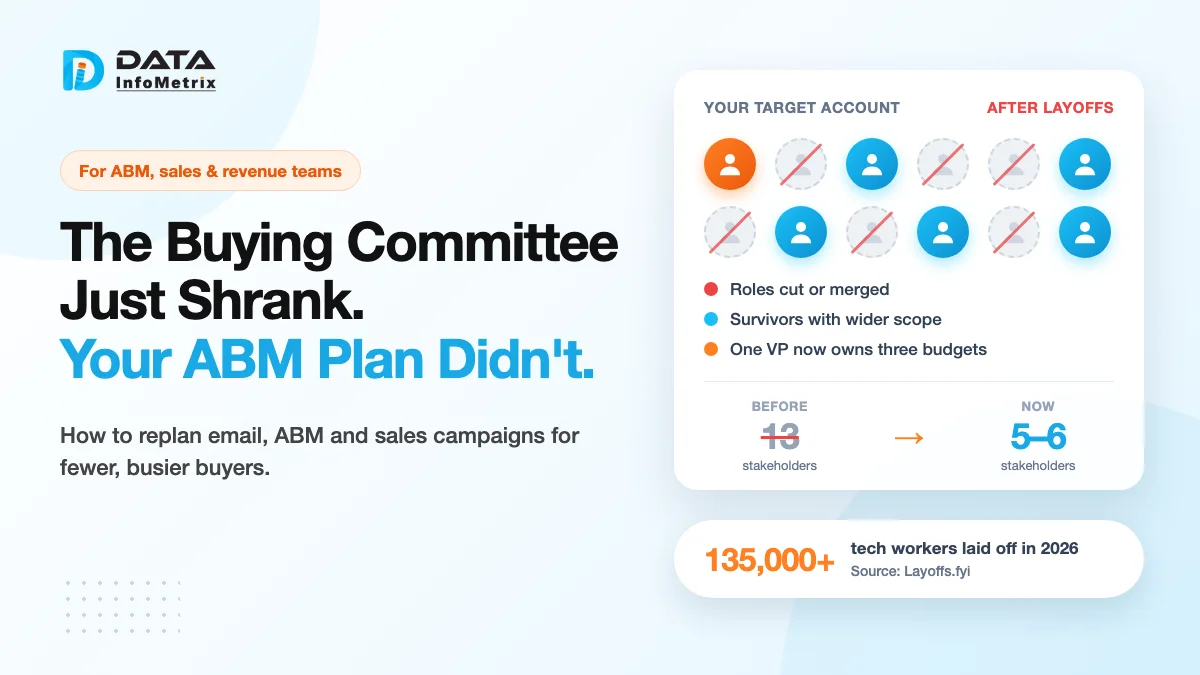
More than 135,000 tech workers have been laid off in 2026, and the buying committees your ABM plan was built around have shrunk with them. Olivia Thomas on how to re-map, re-tier and rewrite your campaigns for fewer, busier buyers.
 Olivia Thomas · 9 min read
Your Competitor's Renewal Date Is Your Real Launch Date
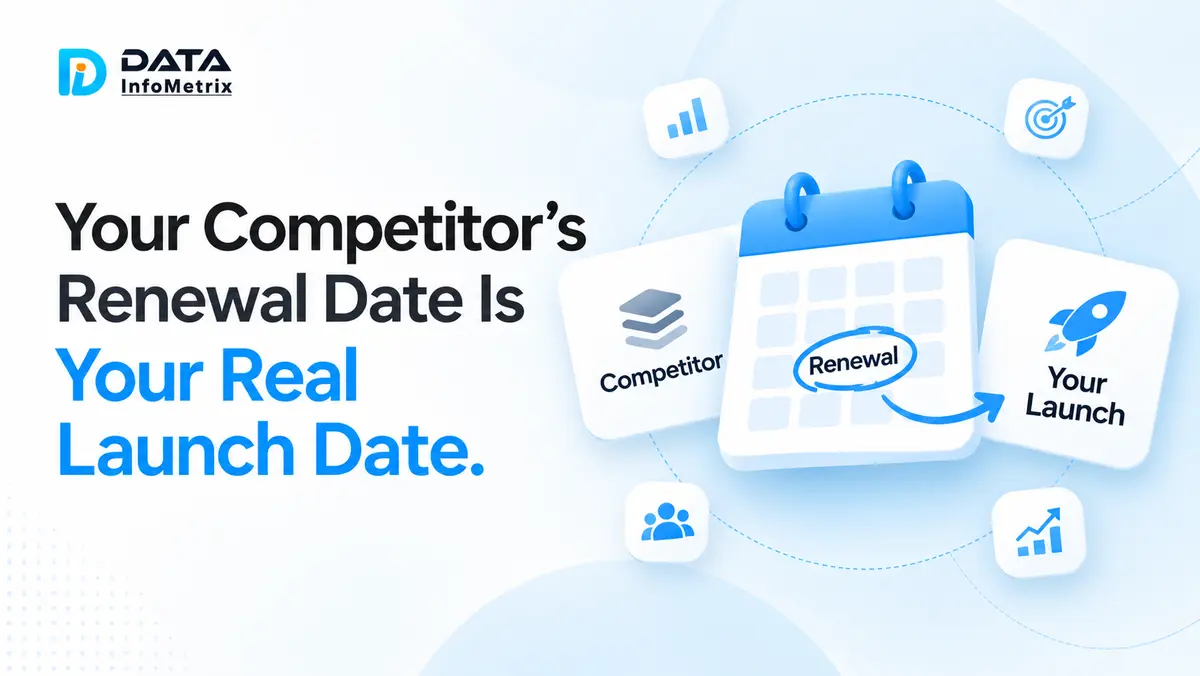
Conquest campaigns fail when they ignore contract cycles. Olivia Thomas on why installed base timing, not messaging, decides who wins a competitor's users.
Olivia Thomas · 6 min read
Anthropic's IPO Filing Shows Who Is Buying AI. Here Is Who Should Be Calling Them.
Anthropic's S-1 puts hard numbers on enterprise AI adoption. For the vendors, integrators, and consultants built around that adoption, the real question is which accounts to reach first, and how to find them before a competitor does.
Olivia Thomas · 8 min read