







The Half-Life of a Tech Stack: How Fast Installed Base Data Goes Stale
Installed base data goes stale twice: when people leave and when companies switch software. A list pulled in Q1 is 20% to 30% wrong by Q3. John Britton on the half-life of a tech stack, and how to tell whether the data you buy is fresh.
On this page11 min read
By John Britton, VP of Marketing at Data InfoMetrix
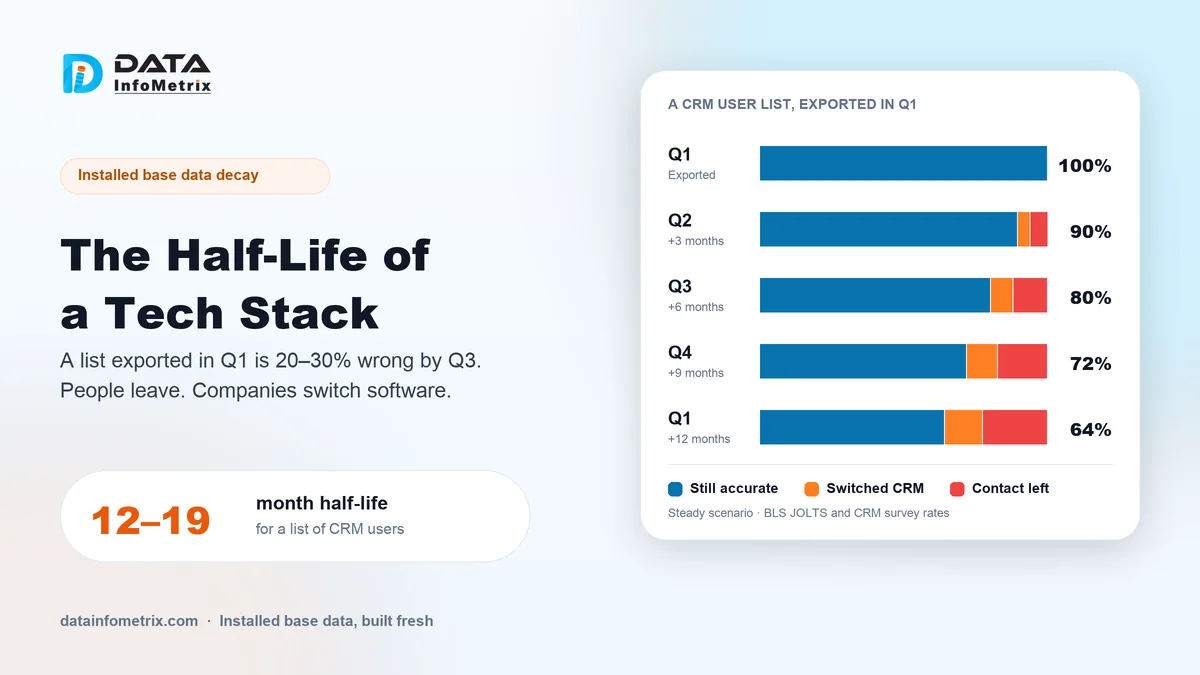
The short answer: Installed base data goes stale on two clocks at once. People leave the companies on your list, and those companies replace the software you targeted them for. Using current US labor data and CRM replacement rates, a list of CRM users exported in January is 20% to 30% wrong by July, and its half-life is roughly 12 to 19 months. A database export can't keep up with that. A list built fresh for the campaign can.
- Every month, about 2% to 3% of US workers leave their employer (BLS).
- In a 2022 survey, 17% to 26% of companies had replaced their CRM in the previous year.
- A record is only right if both are still true, so it decays faster than either part on its own.
Here is a situation I see every quarter. A team buys a list of companies using a competitor's CRM in January. Planning, approvals and copywriting take a while, and the campaign launches in July. The bounce rate is higher than expected. A few replies say "we moved off that last spring." One prospect politely points out that the person you addressed left the company in March.
Nothing went wrong with the campaign. The list was simply true in January and not in July.
Most people know contact data goes out of date. Fewer think about the second clock: the technology itself changes. For anyone running competitor conquesting, integration or migration campaigns, that second clock matters just as much, because the technology is the reason the company is on the list in the first place.
So I wanted to put numbers on it. How fast does installed base data actually go stale?
Installed base data decays on two clocks
An installed base record makes two claims: this person works at this company, and this company uses this technology. Each claim has its own clock.
Clock one: people move
The US Bureau of Labor Statistics' most recent Job Openings and Labor Turnover report puts total separations at 3.3% of employment in September 2026, with quits alone at 2.1%. That is every month. Its September 2026 tenure release found that 20.6% of wage and salary workers had been with their current employer for a year or less, and that median tenure in the private sector is 3.9 years.
Clock two: stacks move
Software changes more often than most people assume. In a survey of 300 marketing executives by Third Door Media, publisher of MarTech, 26% of small businesses had replaced their CRM in the previous year, along with about 17% of mid-sized companies. ERP moves more slowly, but not by as much as people think: Forvis Mazars notes that an ERP system's lifespan is often cited as five to 10 years.
And every software contract comes up for decision regularly. Zylo's 2026 SaaS Management Index found that the average organization runs 305 SaaS applications and manages 211 renewals a year, around four every week. Each renewal is a moment when a tool can be replaced.
What happens to a list exported in Q1
Put the two clocks together and you can model what happens to a list after it is exported. I took a list of companies using a particular CRM, with one contact at each, and applied the rates above month by month. The steady scenario uses the quits rate and the mid-sized CRM replacement rate. The fast scenario uses total separations and the small-business replacement rate.
- Still accurate
- Company replaced its CRM
- Contact left the company
- Q1Exported in January100%accurate
- Q2April, 3 months later90%accurate
- Q3July, 6 months later80%accurate
- Q4October, 9 months later72%accurate
- Q1 +1January, 12 months later64%accurate
- Q1Exported in January100%accurate
- Q2April, 3 months later84%accurate
- Q3July, 6 months later70%accurate
- Q4October, 9 months later59%accurate
- Q1 +1January, 12 months later49%accurate
Contacts leave at the US quits rate (2.1% a month); 17% of companies replace their CRM in a year.Contacts leave at the US total separations rate (3.3% a month); 26% of companies replace their CRM in a year. Model, not measurement: it leaves out role changes inside the same company, closures and acquisitions, which make real decay faster.
Three months after export, the list is already 10% to 16% wrong. By Q3, 20% to 30% of records are no longer true: 12% to 18% of contacts have left, and 9% to 14% of companies have replaced the CRM you were targeting. A year after export, 36% to 51% of the list is wrong.
The steady scenario lines up closely with what we see in practice. Its 12-month contact loss of 22.5% matches the widely cited annual contact decay rate, and its total of 36% wrong after a year is close to the 35% annual figure in our Technology Data Decays Twice whitepaper.
And the model is generous. It leaves out people who change roles inside the same company, companies that close or are acquired, and partial switches, where a company keeps the old system for one division while moving the rest. All of those make real lists decay faster.
The half-life of a tech stack
Half-life is a useful way to think about this. It is the time it takes for half of the records in a list to stop being true.
- A CRM user recordContact still there and company still on that CRM12–19months
- The contactStill at the same company21–33months
- The CRMCompany still on the same CRM28–45months
- The ERPCompany still on the same ERP42–83months
Half-life is the time until half of the records are no longer true. Each bar spans the slow and fast ends of the published rates. Because a record needs both the contact and the technology to be current, it decays faster than either part on its own.
On its own, a contact has a half-life of roughly 21 to 33 months. A CRM has a half-life of about two to four years, and an ERP roughly three and a half to seven. But an installed base record needs both things to be true at once, so its half-life is shorter than either: about 12 to 19 months for a CRM user list.
That is the number that matters when you buy installed base data. If a vendor's database was last refreshed six months ago, you aren't buying a slightly old list. You're buying one that is already a third to half of the way to its half-life.
Why the stack clock is speeding up
The CRM survey above is from 2022. Several things suggest technology is changing faster now, not slower.
Deadlines are forcing migrations. 
AI is reshuffling portfolios. Zylo found that SaaS portfolio size stayed flat year over year, yet large enterprises add an average of 21 applications every month. If the total isn't growing, those new tools are replacing old ones. That is a lot of turnover hiding inside a stable number.
Layoffs are consolidating stacks. When teams shrink, overlapping tools get cut first. In our State of the Installed Base 2027 report, we found that AI-era layoffs are cutting seats before they cut customers. But merged teams also retire duplicate tools, and those retirements remove companies from an installed base entirely.
Acquisitions create uncertainty. When a vendor is acquired, its customers reconsider. 

Where stale installed base data does the most damage
A stale contact list costs you bounces. A stale installed base list costs you more, because the technology is usually the message.
- You pitch a platform the prospect no longer uses. "We help
HubSpot teams migrate faster" lands badly at a company that moved to
- You miss the companies that just switched. A company that adopted a platform last quarter is often the best prospect for integrations, implementation help and add-ons. An old export can't contain it.
- Your bounce rate damages your domain. Departed contacts become hard bounces. Mailbox providers watch bounce rates closely, and a bad send can hurt every campaign after it, not only this one.
- Your sizing is wrong. Territory plans and TAM estimates built on old counts overstate shrinking installed bases and understate growing ones. That changes where you put your reps.
- Your reps lose time. Every dead record is a call, an email and a research session that goes nowhere.
How to tell whether installed base data is fresh
"Updated regularly" tells you nothing. Before you buy, ask these five questions.
- When was each record verified? Ask for a verification date per record, not a database refresh date. A database can be "refreshed monthly" while most of its records were last checked a year ago.
- What is the evidence the company still uses the technology? A job post from two years ago, a stale website tag and a recent integration listing are not equal evidence. Ask what the signal is and how old it is.
- How are switches detected? Ask how the vendor finds out a company has moved off a platform. If the answer is "when a customer tells us", the data only ever adds records and never removes them.
- What happens when an email bounces? A deliverability guarantee with a replacement policy shows the vendor is confident the data is current. No guarantee usually means the opposite.
- How old will the data be on the day you send? Count from verification to launch, not to delivery. For cold outbound, our whitepaper recommends no more than 30 to 45 days.
It also helps to match refresh cadence to the job. Cold outbound needs the freshest data. ABM and ad targeting can tolerate a little more age. Territory planning and TAM sizing can run on quarterly refreshes, because they work at the account level rather than the contact level.
Get an Installed Base List Built Fresh for Your Campaign
We build every list to order, verify it right before delivery, and replace every hard bounce one for one. Start with a free sample of the technology you sell into.
Get a Free Sample →Why we build lists fresh instead of exporting them
This is the reason Data InfoMetrix doesn't sell exports from a static database. If the half-life of a CRM user list is about a year, then any list that sits in a database between builds is losing value every day it waits for a buyer.
So we work the other way around. We start from your brief: the technologies, the company sizes, the regions and the roles you need. We source and confirm current technology use for that brief, verify every contact with SMTP checks and remove bounces and spam traps, then deliver it. The clock starts when you receive the list, not months earlier. We guarantee 99% email deliverability and replace every hard bounce one for one. Our methodology page explains how.
We maintain 997 technology lists covering 238M+ contact records, but those counts are where we start, not what we ship. What you receive is built for your campaign and checked on the way out.
Key takeaways
About the model
The decay model applies two independent monthly rates to a list of companies using a given CRM, with one contact per company. Contact loss uses the BLS JOLTS quits rate (2.1% a month, steady scenario) and total separations rate (3.3%, fast scenario) for September 2026. CRM replacement uses the 17% (mid-sized companies) and 26% (small businesses) annual rates from Third Door Media's 2022 survey, spread evenly across the year. A record counts as accurate only if the contact is still at the company and the company still uses the CRM. ERP half-life assumes the five to 10 year lifespans cited by Forvis Mazars. The labor rates are economy-wide and the CRM rates come from one survey, so treat the results as a range, not a precise measurement.
Frequently asked questions
How fast does installed base data go stale?
Using current US labor turnover and CRM replacement rates, a list of CRM users exported in January is about 20% to 30% wrong by July, and 36% to 51% wrong a year after export. Its half-life, the time until half the records are no longer true, is roughly 12 to 19 months.
Why does technology data decay faster than contact data?
An installed base record makes two claims: the person still works at the company, and the company still uses the technology. Contacts leave their employers and companies replace software, so a record decays on both clocks at once and goes stale faster than either part on its own.
How often do companies switch CRM systems?
In a survey of 300 marketing executives by Third Door Media, publisher of MarTech, 26% of small businesses and about 17% of mid-sized companies had replaced their CRM in the previous year.
How often do companies replace their ERP?
Less often than CRM, but regularly. ERP lifespans are often cited as five to 10 years, and deadlines such as the end of SAP ECC mainstream maintenance in 2027 are pushing many companies into a migration decision.
How often do employees leave their jobs?
In September 2026, US total separations ran at 3.3% of employment per month and quits at 2.1%, according to the BLS Job Openings and Labor Turnover Survey. In January 2026, 20.6% of wage and salary workers had been with their employer for a year or less.
How can I tell if installed base data is fresh?
Ask for a verification date for each record rather than a database refresh date, the evidence that each company still uses the technology, how the vendor detects switches, what its bounce guarantee is, and how old the data will be on the day you send. For cold outbound, keep data under 30 to 45 days old.
 Written byJohn BrittonVP of Marketing at Data InfoMetrix / MedicalProspects
Related articles
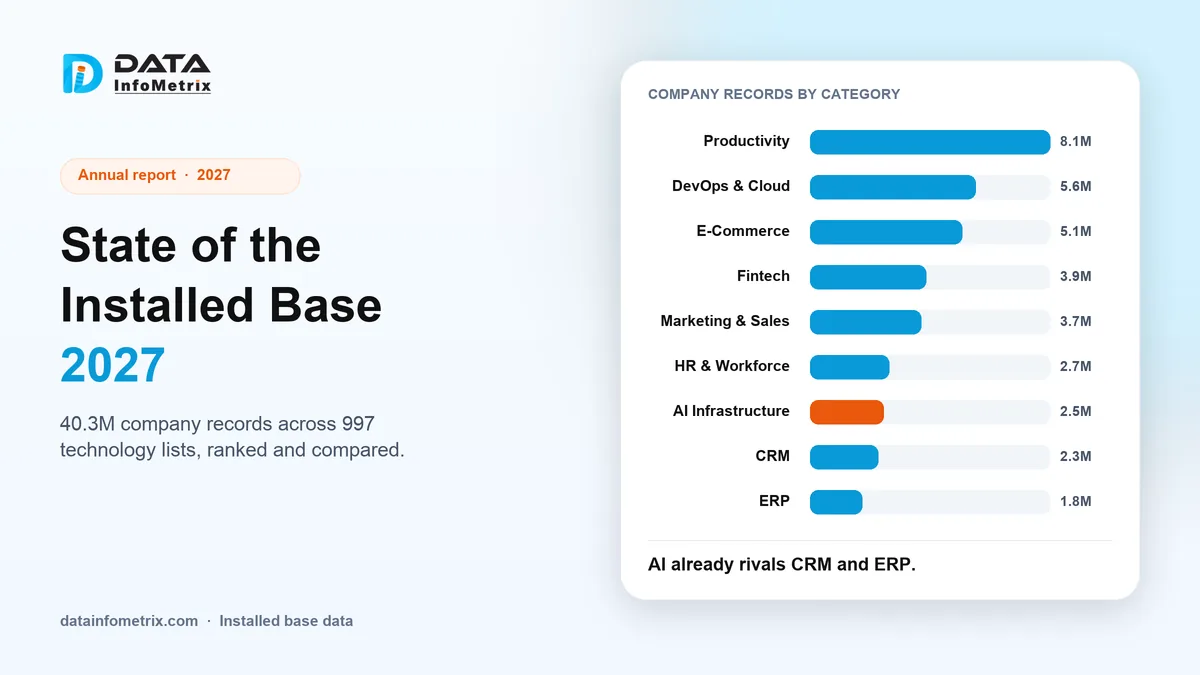
State of the Installed Base 2027: What 997 Technology Lists Say About Where B2B Software Lives
Our first annual report on the B2B installed base, built from 40.3M+ company records across 997 technology lists. Where software is concentrated, how AI compares with CRM and ERP, how AI-era layoffs are shrinking seats, and what it all means for 2027 campaigns.
John Britton · 27 min read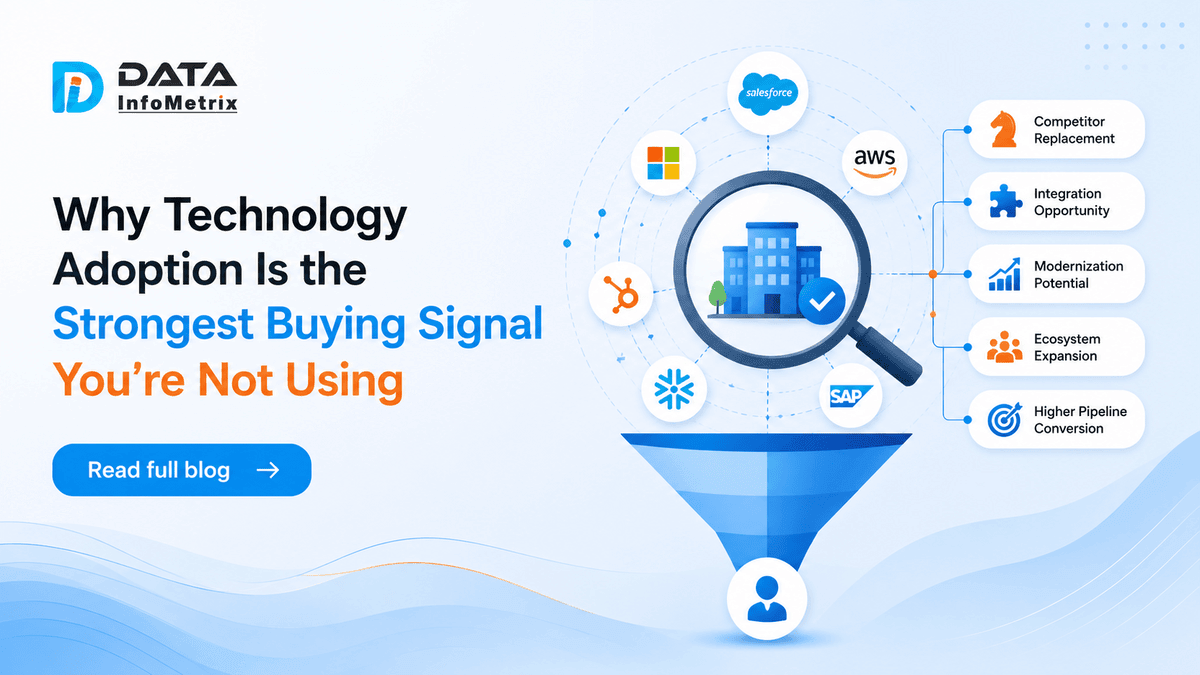
Why Technology Adoption Is the Buying Signal Most Revenue Teams Still Ignore
Most B2B teams still build target lists by asking if an account fits their ICP. Learn why technology adoption—what a company already runs—is the ultimate buying signal that predicts why and when accounts convert.
 Olivia Thomas · 11 min read
Best Installed Base Data Providers in 2027, by Use Case
Installed base data tells you which companies run which technology. Seven providers compared by the job they do best, with how each one collects its data and what to ask before you buy.
Olivia Thomas · 10 min read