







.NET 8 and .NET 9 Just Lost Support. Here Is Who Should Be Calling Those Companies.
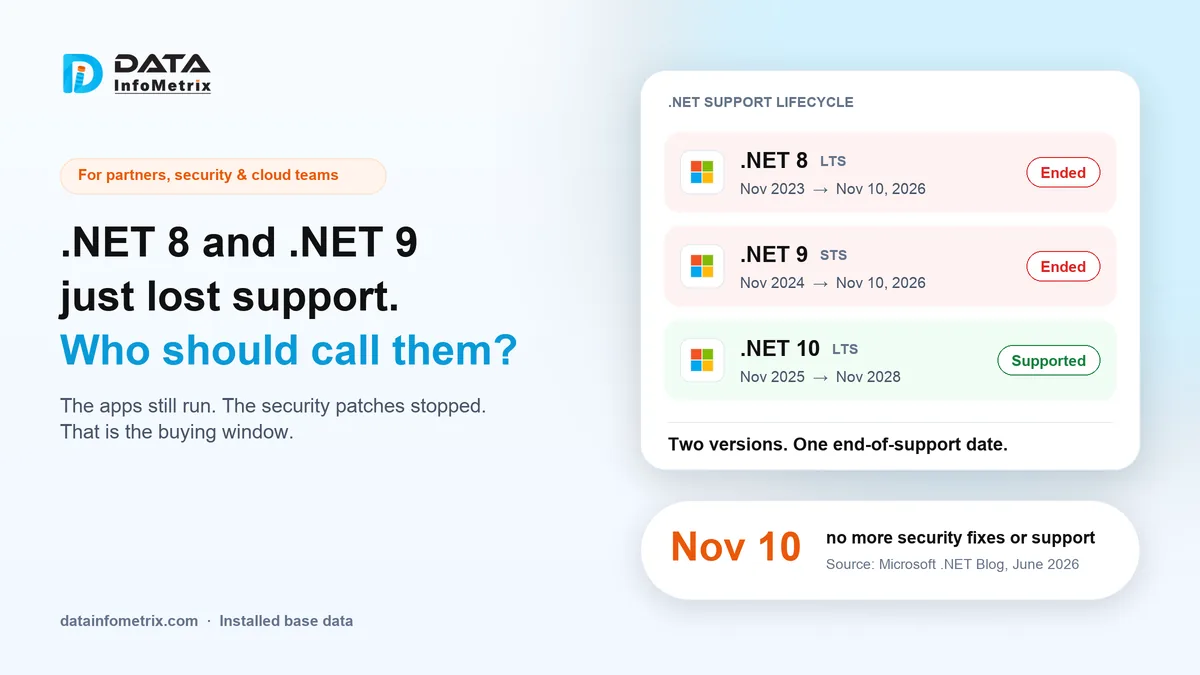
On November 10, 2026, Microsoft stopped patching .NET 8 and .NET 9. The apps still run, which is exactly why so many companies will leave them alone. Olivia Thomas on who should be reaching those companies, and how to find them.
On this page9 min read
By Olivia Thomas, Director of Growth Marketing & Sales at Data InfoMetrix
The short answer: Microsoft ended support for both .NET 8 and .NET 9 on November 10, 2026. Applications built on them keep running, but they no longer get security fixes or technical support. That creates a buying window for modernization partners, application security vendors, cloud and hosting providers, extended-support providers and managed service firms. The hard part is finding the companies affected, because the .NET version an app runs on is rarely visible from the outside.
- Two versions lost support on the same day, so the affected base is unusually large.
- Nothing breaks on the deadline. That is why many teams will wait, and why outreach matters.
- Find accounts through signals: job posts, developer hiring, Microsoft-heavy stacks and security tooling.
Last Tuesday, two of the most widely deployed versions of Microsoft's development platform went out of support on the same day.
Nothing crashed. No website went dark. On Wednesday morning, every application built on .NET 8 or .NET 9 started exactly as it did the day before.
That is the problem, and the opportunity. A deadline that breaks things forces a decision. A deadline that quietly stops the security patches gets added to a backlog. For a lot of companies, that backlog is where .NET 8 will sit for the next year.
If you sell services or software that help companies modernize, secure or run their applications, this is one of the clearest buying windows of the year. I want to walk through what changed, who should be reaching these companies, and how to find them when the version number isn't something you can see from the outside.
What happened on November 10
Microsoft announced it on its .NET blog in June, and the date did not move. In the words of the official end-of-support announcement, after November 10, 2026, Microsoft "will no longer provide servicing updates, security fixes, or technical support for these versions." The recommended path is .NET 10, a long-term support release supported through November 2028.
Two details make this deadline bigger than usual.
Two versions ended on one day. .NET 8 is a long-term support release that shipped in November 2023 with a 36-month window. .NET 9 was a standard-term release that would originally have expired in May 2026, but Microsoft extended standard-term support to 24 months in September 2025. That moved .NET 9's end date to the same day as .NET 8. Teams that skipped ahead to 9 and teams that stayed on the long-term release are now in the same position.
Other clocks ran out alongside it. PowerShell 7.4 and 7.5, which are built on .NET 8 and .NET 9, reached end of life on the same date, and so did servicing for the Enterprise and Education editions of Windows 11 version 23H2, as endoflife.ai's November 10 roundup lays out. For an IT team, that is several upgrade conversations landing in the same quarter.
How big is the affected base?
Nobody publishes a clean count of applications running a specific .NET version, and I'd be wary of anyone who claims one. What we do know is how widely the platform is used.
In the 2025 Stack Overflow Developer Survey, 27.8% of respondents used C#, and 19.7% used ASP.NET Core, the web framework built on modern .NET. That puts .NET among the most common stacks for business applications: internal line-of-business systems, customer portals, APIs, and a lot of the software that runs finance, logistics and healthcare operations.
And because .NET 8 was the long-term release, it is the version many enterprises standardized on. Long-term releases are what cautious teams pick precisely so they don't have to upgrade often. Those are also the teams least likely to have moved in the first week.
Why so many companies will wait
On paper, the upgrade is small. InfoWorld's summary notes that the first step is changing the target framework in the project file. In practice, the work is everything around that line:
- Dependencies. Third-party libraries and internal packages all need versions that support .NET 10.
- Testing. Every application needs regression testing, and older apps often have thin test coverage.
- Pipelines and hosting. Build agents, container images and hosting environments all need updating.
- Competing priorities. An upgrade that adds no features loses to almost anything on the roadmap.
So teams wait. Meanwhile, every month without patches adds risk, and that risk eventually shows up somewhere a budget holder can't ignore: a security review, a customer questionnaire, an audit finding or an insurance renewal that asks about unsupported software.
That gap between "we should" and "we have to" is where sales conversations happen. I wrote about the same dynamic for the SAP ECC deadline. The difference here is speed: the .NET deadline has already passed.
Who should be calling these companies
Six kinds of companies have a natural reason to reach out right now. Each needs a slightly different audience.
1. .NET modernization and implementation partners
The most direct fit. Many internal teams would rather hand the upgrade to a partner than pull developers off the roadmap. Fixed-scope offers work well: an inventory of apps and dependencies, an upgrade plan, then the upgrade itself. Your buyers are engineering managers, application owners and the CIO's office. Our legacy modernization audiences are built for this kind of campaign.
2. Application security vendors
Unpatched runtimes are exactly what software composition analysis and code scanning tools are designed to flag. If you compete with tools like Snyk, Veracode, Checkmarx or SonarQube, the companies already running them have visibility into the problem. The ones without that tooling may not know how many of their apps are affected. Both are worth a conversation, with different messages.
3. Cloud and hosting providers
Upgrades are a natural moment to revisit where an app runs. Azure has posted its own retirement notice telling customers to move .NET 8 apps to .NET 10. For providers and partners in the Microsoft Azure ecosystem, that gives a ready-made reason to start a migration or optimization conversation.
4. Extended-support providers
Some companies simply can't upgrade in time, often because an application is old, poorly documented or about to be replaced. A small market of third-party providers offers continued security patches for out-of-support .NET versions, such as HeroDevs with its Never-Ending Support for .NET. Their buyers are the teams that know they'll be late.
5. DevOps, testing and observability vendors
An upgrade touches the build pipeline, the deployment process and the monitoring around every app. Teams using tools like GitHub, Octopus Deploy or Datadog will be changing configurations anyway. If your product makes that safer or faster, the timing is on your side.
6. Managed service providers
Mid-sized companies often have a handful of .NET applications and no dedicated platform team. An MSP that offers "we'll handle the upgrade and keep you patched" solves the whole problem in one sentence.
How to find the companies still on .NET 8 and 9
This is where most campaigns stall. A website can show you that a company uses Salesforce or Shopify. It almost never tells you which .NET version an internal application runs on. So you build the audience from signals instead of a single field:
- Hiring signals. Job posts that ask for .NET 8, ASP.NET Core 8 or an upcoming .NET migration are the strongest public evidence of what a team runs and what it plans to do.
- Development stack. Companies running Visual Studio, Azure DevOps, SQL Server and Azure App Service together are very likely building on .NET.
- Developer headcount. A company with a sizeable in-house .NET team has more applications to upgrade, and more to gain from help.
- Security and compliance pressure. Regulated industries such as finance, healthcare and the public sector feel unsupported-software risk first.
- Recent activity. Teams that already moved one app to .NET 10 are mid-migration and may be looking for capacity to finish.
Stack these signals together and you get a ranked list of accounts with a real reason to talk now, instead of every company that has ever posted a C# job. The same thinking applies to any technology buying signal: one signal is a hint, several together are a pattern.
Find the Companies Still Running .NET 8 and .NET 9
We build custom lists of .NET development teams from hiring and stack signals, with the engineering and IT leaders mapped and verified.
Request a Custom .NET Audience →What to say when you reach them
Fear doesn't work well here. The people you're writing to know the deadline passed. Most of them already have a plan, even if the plan is "later." What helps is making "later" cheaper and safer.
- Lead with the fact, not the threat. "Your .NET 8 apps still run. They stopped getting security patches on November 10." That's accurate and calm.
- Offer the first small step. An inventory of which apps run which version, and what each upgrade involves, is easy to say yes to.
- Make the cost of waiting concrete. Point to the next security review, customer questionnaire or audit, not a vague breach scenario.
- Talk to the right people. Engineering managers own the work. Security and compliance leaders own the risk. The CIO or CTO owns the budget. A campaign that reaches all three moves faster.
A short first email might read:
"Hi {{first_name}}, Microsoft stopped patching .NET 8 and .NET 9 on November 10. Nothing breaks today, but every month adds risk. We help teams like yours inventory their .NET apps and upgrade to .NET 10 without pulling developers off the roadmap. Would a 20-minute walkthrough of what that looks like for {{company}} be useful?"
This window won't stay open long
Deadline-driven demand peaks early. The companies that move first will pick a partner in the next few months. The ones that wait will find the budget once something forces it, and by then they'll have heard from a lot of vendors.
There's also a longer arc. .NET 10 is supported through November 2028, and Microsoft ships a new version every November. The teams that build a repeatable motion for this deadline will be ready for the next one, and the one after that. The same is true of any date-driven campaign: the advantage goes to whoever knows which accounts are affected before the deadline, not after.
How we build .NET audiences at Data InfoMetrix
We don't have an off-the-shelf ".NET 8 users" list, and I'd be suspicious of anyone who says they do, for the reasons above. Instead, we build the audience fresh from the signals that matter for your offer: development stack, hiring activity, team size, industry and region, with the engineering, security and IT leaders mapped at each account.
Every contact is SMTP-verified, with bounces and spam traps removed before delivery. We guarantee 99% email deliverability and replace every hard bounce one for one. With 238M+ installed base contacts across 997 technology lists, we have the reach. Building the list around your specific offer is what makes it worth sending.
If you sell modernization, security, cloud or support services, the companies that need you most are the ones that haven't moved yet. The question is whether you reach them before the next vendor does.
Frequently asked questions
When did .NET 8 and .NET 9 reach end of support?
Both reached end of support on November 10, 2026. After that date Microsoft no longer provides servicing updates, security fixes or technical support for either version. Microsoft recommends upgrading to .NET 10, a long-term support release supported through November 2028.
Do .NET 8 applications stop working after end of support?
No. Applications built on .NET 8 or .NET 9 keep running. They simply stop receiving security patches and technical support from Microsoft, so the risk grows each month they stay on an unsupported version.
Why did .NET 9 reach end of support at the same time as .NET 8?
.NET 9 is a standard-term support release. In September 2025 Microsoft extended standard-term support from 18 to 24 months, which moved the .NET 9 end date from May 2026 to November 10, 2026, the same day as .NET 8.
Who should sell to companies still running .NET 8 or .NET 9?
The strongest fits are .NET modernization and implementation partners, application security vendors, cloud and hosting providers, third-party extended-support providers, DevOps and observability vendors, and managed service providers.
How can you find companies that still run .NET 8 or .NET 9?
The .NET version an application runs on is rarely visible from outside. Build the audience from combined signals: job posts that mention .NET 8 or ASP.NET Core 8, a Microsoft-heavy development stack, in-house .NET developer headcount, industry compliance pressure and recent migration activity.
Can Data InfoMetrix build a list of .NET development teams?
Yes. Data InfoMetrix builds custom .NET audiences from hiring and technology stack signals, with engineering, security and IT leaders mapped at each account. Contacts are SMTP-verified with a 99% deliverability guarantee and one-for-one replacement of every hard bounce.
 Written byOlivia ThomasDirector of Growth Marketing & Sales
Related articles
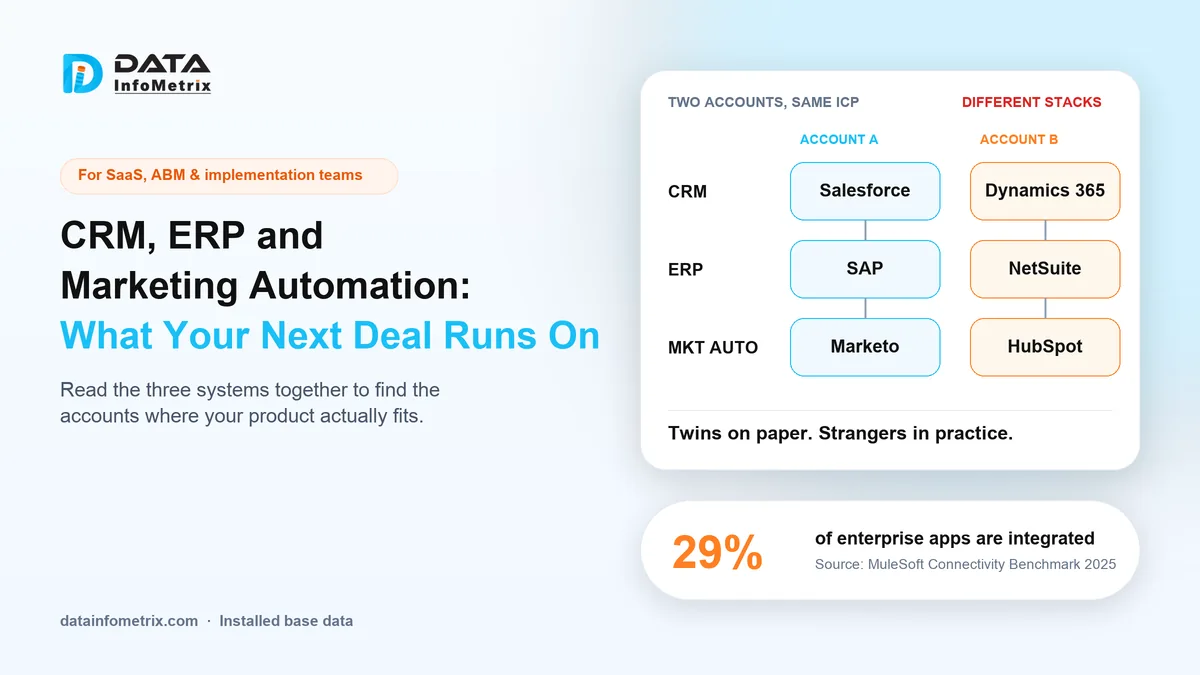
The Hidden Relationship Between CRM, ERP and Marketing Automation (And What It Tells You About Your Next Deal)
Two accounts can look identical on a firmographic scorecard and still be completely different opportunities. John Britton on reading CRM, ERP and marketing automation together to find where your product actually fits.
 John Britton · 11 min read
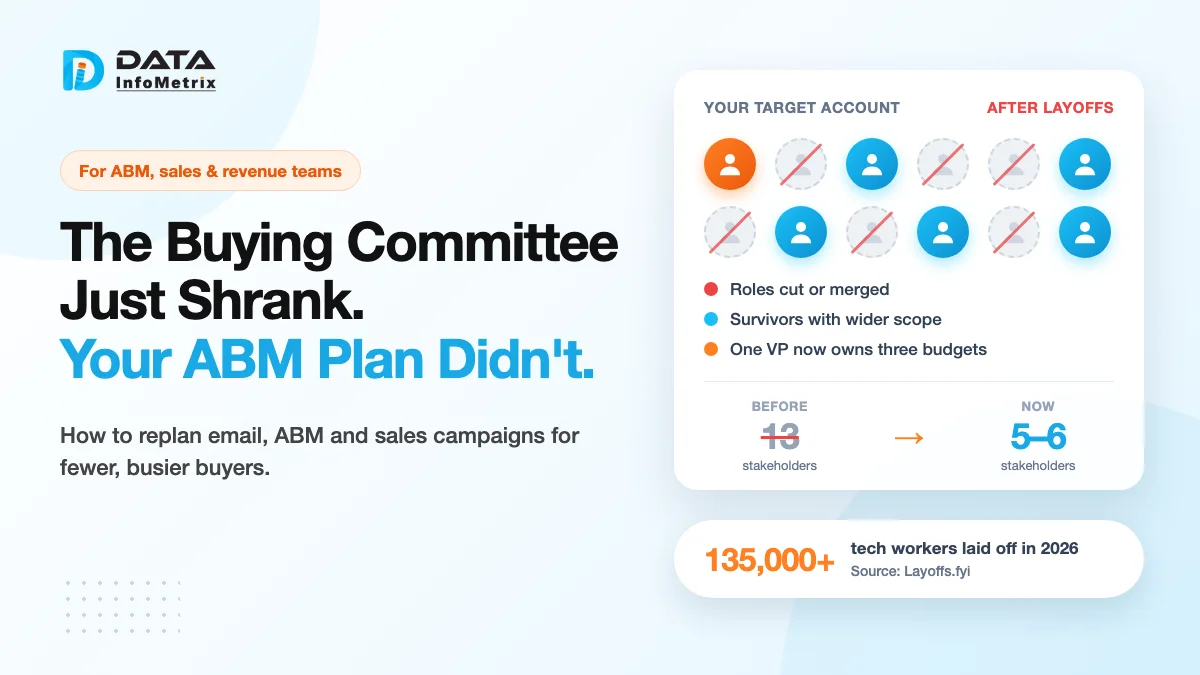
The Buying Committee Just Shrank. Your ABM Plan Didn't.
More than 135,000 tech workers have been laid off in 2026, and the buying committees your ABM plan was built around have shrunk with them. Olivia Thomas on how to re-map, re-tier and rewrite your campaigns for fewer, busier buyers.
Olivia Thomas · 9 min read
Your Competitor's Renewal Date Is Your Real Launch Date
Conquest campaigns fail when they ignore contract cycles. Olivia Thomas on why installed base timing, not messaging, decides who wins a competitor's users.
Olivia Thomas · 6 min read