




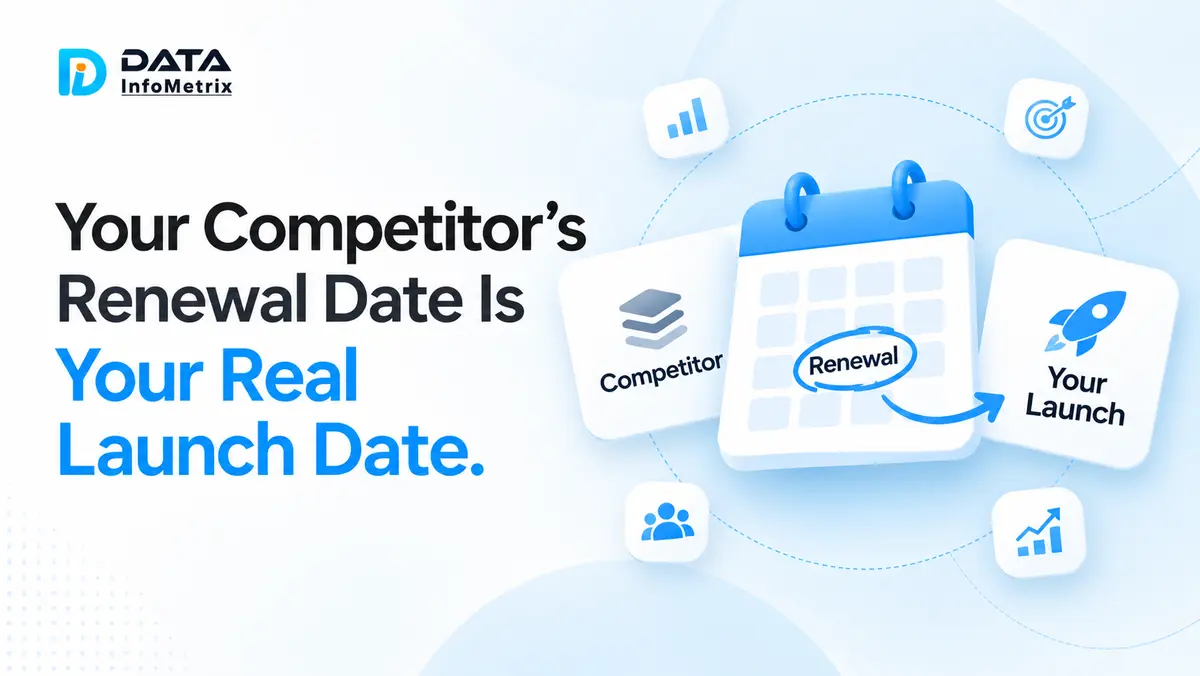
Your Competitor's Renewal Date Is Your Real Launch Date
Conquest campaigns fail when they ignore contract cycles. Olivia Thomas on why installed base timing, not messaging, decides who wins a competitor's users.
By Olivia Thomas, Director of Growth Marketing & Sales at Data InfoMetrix
Some years ago I sat in a quarterly review and watched a conquest campaign get politely buried.
On paper it had everything. A clean list of roughly four thousand accounts running the market leader's platform. Sharp creative. A comparison page the product team was proud of. Open rates looked healthy, and the SDRs booked a respectable number of first calls.
Then nothing moved. Prospects agreed with every point we made about the incumbent. They nodded through demos. And then they told us, almost word for word, “Come back when we're up for renewal.”
The one deal we closed that quarter came from an account whose contract happened to expire seventy days after our first email. Pure luck. We hadn't planned for it, and we certainly hadn't built the campaign around it.
That quarter changed how I think about competitive displacement. The list was right. The message was right. The calendar was wrong.
Conquest campaigns usually fail on timing, not targeting
Most teams I talk to treat a competitor users list as a static asset. Pull the accounts, load the sequence, launch. The assumption is that a frustrated user of a rival product is a buyer in waiting.
Frustrated, yes. Buyer, not yet.
According to a study by Gartner, in its survey of technology buyers involved in “as-a-service” renewal and expansion decisions, 2023, 60% of those buyers said they regret nearly every purchase they make, a 6% increase over 2020. Read that the way a seller would and it sounds like an open door. I read it differently now. Regret is not action. Most regretful buyers I've met do nothing until the contract forces a decision, because switching mid-term means paying twice, retraining people, and explaining the whole mess to finance.
The renewal is where regret finally turns into a decision. According to a recent study by Telarus, in its 2026-27 Tech Trends Report, 2026, 84% of buyers are open to switching vendors at renewal, and 87% reported rising renewal costs. The two words that matter in that finding are “at renewal.” Not halfway through a three-year term. Not because your banner ad was clever. That 84% describes a window, and windows close.
How many of the accounts in your current conquest campaign could you place on a renewal calendar today?
The decision is made before the renewal arrives
This is where conquest plans go sideways a second time. Teams that do respect contract cycles often launch 60 or 90 days before the renewal date. It feels disciplined. It is usually too late.
According to a recent study by 6sense, in its 2025 Buyer Experience Report, 2025, 94% of buying groups had ranked their preferred vendors before first contact with a seller, and they went on to buy from that early favorite 77% of the time. The same research put the average buying cycle at about ten months.
Ten months. Put that next to a twelve-month contract.
If the buying group starts evaluating ten months before it signs, and picks a favorite before it ever books a demo, then a campaign landing 60 days before renewal isn't opening a conversation. It's auditioning for a decision someone already made. I've been on the losing end of that more than once, and the feedback is always some version of “we'd already shortlisted.”
One more line from that report deserves a sticky note on every conquest marketer's monitor. Seventy percent of buyers said economic anxiety directly influenced their vendor choice, and 6sense notes this often favored incumbents. In an uncertain year the default is to stay put. Your job is to become the credible alternative before that default hardens into a signature.
So when should your campaign actually start?
Renewals are a queue, and yours is one ticket in it
It helps to see renewals from the buyer's side of the table.
According to a recent study by Zylo, in its 2026 SaaS Management Index, 2026, the average organization handles 211 SaaS renewals a year, close to one every business day. The same index found that 79% of IT leaders ran into price increases at renewal over the previous twelve months.
Picture the procurement lead looking at that queue. Your competitor's contract is one line in a spreadsheet of two hundred. Unless somebody inside the account has already said “let's look at alternatives this time,” that line renews on autopilot. Nobody wakes up on renewal day eager to run an evaluation.
The price increases are your opening, though. I've seen more competitive deals turn on a renewal quote than on any feature gap. The catch is that the quote tends to arrive a couple of months out. If your name isn't already familiar when that email lands in the CFO's inbox, a different challenger's will be.
Why generic databases can't put a clock on your pipeline
This part frustrates me about how a lot of B2B data still gets bought.
A generic database tells you a company is a 600-person manufacturer in Ohio with a VP of IT. Fine, as far as it goes. It doesn't tell you the company runs an on-premise ERP it has had for nearly a decade, or that the deployment is old enough that a platform decision is coming whether anyone likes it or not.
Without knowing the incumbent technology, there's no clock to read. You cannot time a renewal you cannot see. Every “personalized” email becomes a guess, and every SDR call opens with discovery questions the buyer is tired of answering.
Installed Base Data is the precondition for timing. Once you know exactly which accounts run the platform you compete against (and ideally which version, and roughly how long it's been in place), the renewal calendar stops being a mystery and becomes a planning tool.
How I'd sequence a renewal-led conquest campaign
I don't love rigid frameworks. Buying groups are messy, and contracts get renegotiated early, extended, or quietly co-termed with something else. But after enough of these campaigns, a rough rhythm has settled in that works far more often than it fails.
Twelve to nine months before renewal: be known, not pitched. Education, aimed squarely at users of the competing platform. Migration guides. Candid comparison content. A webinar on what teams wish they'd known before their last renewal. Nobody is buying yet, which is exactly why they'll read it.
Nine to six months out, the shortlist forms. This is the stretch the 6sense data says decides most deals. Proof matters more than reach here: customer stories from companies that made the same switch, cost comparisons a finance team would believe, implementation timelines that aren't fantasy. If you sell through partners, bring them in now. Not after the demo.
Six to three months. Sales takes the lead. Direct outreach to the buying group, switching incentives if you offer them, migration support spelled out in writing. One thing I push hard on: include finance and procurement, not just the technical owner. They're the ones holding the renewal quote.
And inside ninety days? Mostly you're harvesting what you planted earlier. Pain-driven deals still happen here (a price hike, an outage, a champion who just left), so keep watching. But if an account is clearly renewing, don't burn it. Record the new term and put it back on the calendar. A multi-year renewal you lose today is a pre-scheduled opportunity a few years from now.
You won't always know the exact renewal date. Usually you won't. You can still estimate it. Contract norms vary by category, with annual terms common in SaaS and longer commitments typical for ERP and core infrastructure. Fiscal year-end, when a technology first showed up in the account, a new CIO, job postings for administrators of the incumbent platform, the incumbent announcing a price change: each one narrows the window. None is reliable alone. Together they get you close enough to plan.
What this looked like for one of our clients
Last year we worked with an implementation partner that wanted to win migrations away from a legacy on-premise ERP. Their first instinct was the same one I had years ago. Get the full list, launch everything at once.
We pushed back. Our research team built a custom installed base around their ICP, segmented by version and deployment age, and we verified contacts across the whole buying group rather than IT alone. The partner then staggered outreach in waves keyed to estimated renewal and support windows.
The early waves felt slow, and I'll admit the client was nervous. Meetings were exploratory, more “we're starting to think about this” than “send us a proposal.” By the time those accounts moved into formal evaluation, though, the partner was already on the shortlist. In several cases it was the only firm the buyer had spoken to before the RFP went out.
Same market. Same message. Different calendar.
How we approach this at Data InfoMetrix
When a team asks us for a competitor users list, our first question isn't “which competitor?” It's “who is your ideal customer, and when do they buy?”
Everything we build follows from that answer. The installed base is researched around your ICP rather than pulled from a predefined dataset, so it reflects accounts you can realistically win. It's sourced on demand, which matters more for conquest than almost any other use case; a list built last year still contains companies that have since migrated, and a few of them may have migrated to you.
Verification is the unglamorous part, and the part I'd never skip. Every contact goes through SMTP verification, bounce reduction, and spam trap removal before it reaches your sequences. Reaching a renewal window with a bounced email is a particularly expensive way to miss.
We also map beyond the technical owner. Renewal decisions pull in finance and procurement, and a conquest list that only reaches IT is reaching a third of the room.
Our 70M+ Installed Base Contacts give us the reach. The research methodology is what makes the timing possible.
Why this matters right now
It's November. A large share of contracts renew on January 1 or line up with a fiscal year that begins in the first quarter. If you're planning a Q1 conquest push against those accounts, the math is uncomfortable. Their evaluations started months ago.
Which leaves the real question for your 2027 plan. Are you building campaigns around when your team is ready to launch, or around when your competitor's customers are ready to leave?
Only one of those calendars closes deals.
 Written byOlivia ThomasDirector of Growth Marketing & Sales
Related articles

Anthropic's IPO Filing Shows Who Is Buying AI. Here Is Who Should Be Calling Them.
Anthropic's S-1 puts hard numbers on enterprise AI adoption. For the vendors, integrators, and consultants built around that adoption, the real question is which accounts to reach first, and how to find them before a competitor does.
Olivia Thomas · 8 min read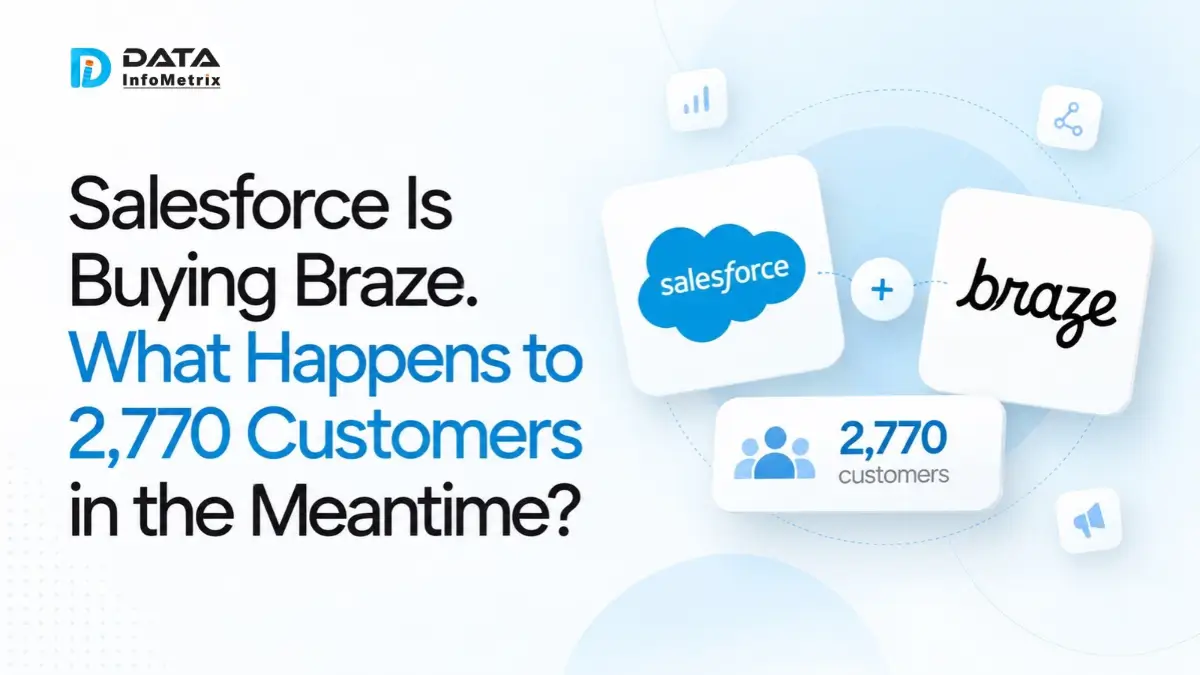
Salesforce Is Buying Braze. What Happens to 2,770 Customers in the Meantime?
Salesforce announced an agreement to acquire Braze for $5.66B. Explore what happens to 2,770 Braze customers, why ownership changes reopen tech renewals, and how GTM teams can navigate the window.
Olivia Thomas · 6 min read
Inside the 2026 Executive Research Series: Announcing 4 Comprehensive eBooks and 4 Empirical Whitepapers on B2B Installed Base Intelligence
Data InfoMetrix releases its landmark 2026 Executive Research Series: 4 tactical eBooks and 4 empirical Whitepapers providing research-backed benchmarks on technographic data decay, legacy migration cycles, and account selection.
Olivia Thomas · 9 min read