





The Buying Committee Just Shrank. Your ABM Plan Didn't.
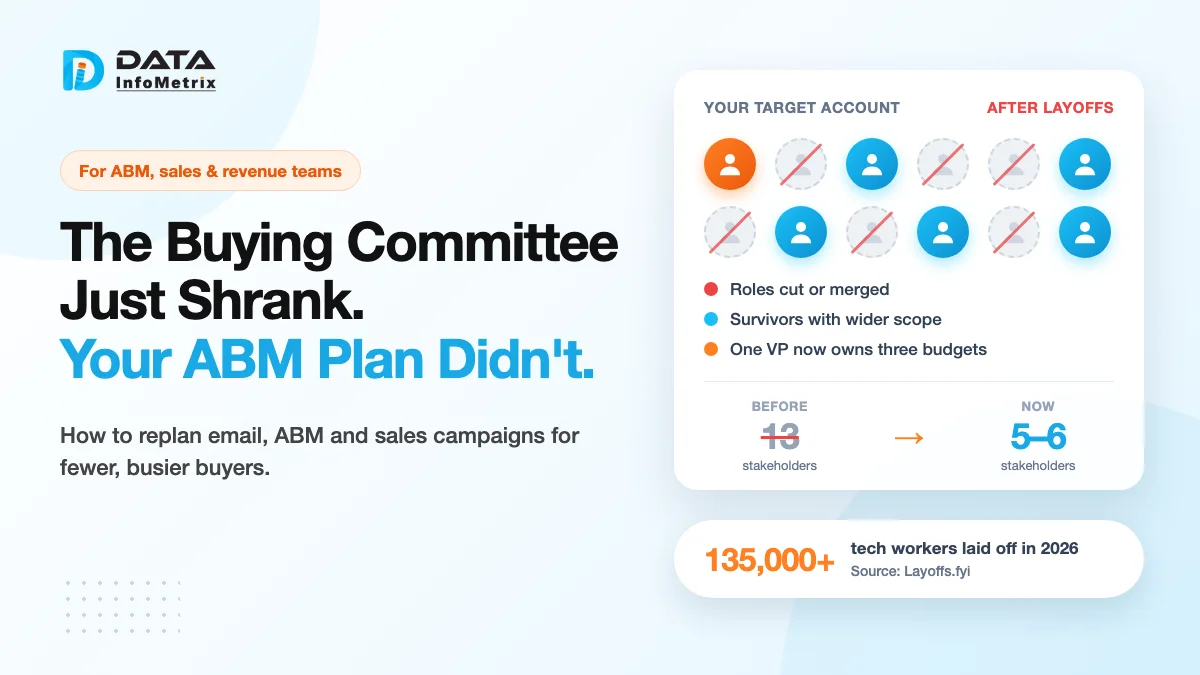
More than 135,000 tech workers have been laid off in 2026, and the buying committees your ABM plan was built around have shrunk with them. Olivia Thomas on how to re-map, re-tier and rewrite your campaigns for fewer, busier buyers.
By Olivia Thomas, Director of Growth Marketing & Sales at Data InfoMetrix
The short answer: Tech layoffs don't only cut jobs. They cut the buying committees that ABM, email and sales campaigns are built around. When a committee of a dozen people drops to five or six, some roles disappear, some merge, and the people who are left own bigger budgets with less time. Campaigns built on last year's org chart reach the wrong people, or nobody at all.
- Re-verify every contact before you relaunch. Layoffs turn good lists into bounce risks fast.
- Map committees around who owns the budget now, not around job titles.
- Re-tier accounts, and rewrite outreach for buyers who have less time and more to justify.
Most of the ABM plans I reviewed this year had the same thing in common. They were built on an org chart that no longer exists.
The target accounts are still there. The technology they run is still there. But the eleven or twelve people the plan was designed to reach have become five or six, and the ones who are left have very different jobs from the ones they had in January.
If you buy email lists for ABM, outbound or sales campaigns, this changes more than your bounce rate. It changes who you should be talking to, what you should say, and which accounts deserve your best effort. Here's how I'd replan.
Tech layoffs are not slowing down
The numbers are hard to ignore. According to Layoffs.fyi, more than 135,000 tech employees at over 330 companies have been laid off so far in 2026. That count is a floor, because many companies never report a number.
Some of the cuts are huge. Oracle alone cut its workforce by about 13% in its last fiscal year, which I wrote about in what Oracle's 2026 layoffs mean for GTM teams. But the bigger story for list buyers is the hundreds of smaller cuts at the companies in your target market.
And there's little reason to expect a quick reversal. Gartner predicted that through 2026, 20% of organizations will use AI to flatten their structure, eliminating more than half of their current middle management positions. Middle managers are exactly the people who used to sit on buying committees, run evaluations and champion vendors internally.
What a layoff does to a buying committee
Forrester's State of Business Buying 2026 found that the typical B2B buying decision includes 13 internal stakeholders. That's the committee most ABM plans were designed for. After a round of layoffs, four things happen to it.
Some roles disappear
The first cuts usually land on roles that support a decision rather than make it. Program managers, operations analysts, the senior manager who ran the vendor evaluation. These are often the people your SDRs were told to start with, because they're easier to reach and more willing to take a first call.
When they go, your entry point into the account goes with them.
Some roles merge: the “one VP now owns three budgets” problem
This is the change I see most often, and the one that breaks campaigns quietly.
A company used to have a VP of Marketing Ops, a VP of Sales Ops and a Director of RevOps. Now it has one VP of Revenue Operations who owns all three budgets. Or the Director of IT Infrastructure and the Director of Security now report to one person who decides on both.
Your list still has three contacts at that account. Two of them may have left. The one who's left is now the single most important person in the deal, and they're getting your campaign three times, written for three different jobs.
The survivors take on more scope
The people who stay inherit work from the people who left. They have more priorities, more meetings and less time to read vendor emails. They also have less patience for anything that adds work, like a long evaluation or a complicated rollout.
Decisions move up
With fewer people in the middle, purchases that a director could approve last year now go to a VP, the CFO or procurement. The committee is smaller, but the bar for proof is higher. Every purchase has to be defended to someone who's watching costs closely.
Why last year's ABM plan breaks
Put those four changes together and you can see why campaigns built six or twelve months ago start to fail.
- Bounces climb. Contacts who left the company turn into hard bounces. Too many of those and your sender reputation drops, which hurts every campaign you send, not only this one.
- Multi-threading falls apart. You planned six contacts per account. Three are gone, one changed roles, and the two who are left aren't the decision makers.
- Personas are wrong. Messaging written for a narrow role lands on someone who now owns a much wider scope, and it reads as irrelevant.
- Tiers are wrong. An account you ranked as Tier 1 may have cut the exact team that would buy from you. Another account may have cut elsewhere and moved budget into your area.
Contact data already decays at roughly 2.1% a month in a normal year, and technology data decays even faster. We measured both in our Technology Data Decays Twice whitepaper. Layoffs speed that up, and they hit hardest in the exact companies and functions you're targeting.
Step 1: Re-verify before you relaunch
Before you change a single message, find out who's still there. I'd do this for any list older than three months, and for any account that announced cuts.
- Re-verify every email before it goes back into a sequence. Remove hard bounces, catch-all risks and spam traps.
- Check job titles and reporting lines for your top accounts. A title change often means a bigger scope, not a demotion.
- Pause sequences to departed contacts and stop auto-replies from triggering follow-ups.
- Log who left and where they went. More on why below.
This is the least exciting step and the one most teams skip. It's also the one that protects your domain for every campaign after it.
Step 2: Re-map the committee around budgets, not titles
Most account maps are built from job titles. After a layoff, titles stop telling you who decides.
For each priority account, I'd ask three questions:
- Who owns the budget for the problem we solve now? It may be a different person, in a different function, at a higher level than before.
- Who will use the product every day? That person may now be doing two jobs, which makes your product more valuable to them if it saves time.
- Who has to approve the spend? Finance and procurement are in more deals than they were a year ago. Plan for them from the start.
The result is usually a smaller map, with five or six people instead of twelve, but each one is more senior and more important. That's fine. A tight map of the right people beats a long list of the wrong ones.
Step 3: Re-tier your accounts
Layoffs don't make every account weaker. They make some accounts weaker and some stronger, and your tiers should reflect that.
Move accounts down when the cuts hit the team that would buy from you, or when the company is clearly cutting all new spend.
Move accounts up when the cuts hit other areas while the company keeps investing in yours. A company that lays off 10% of staff and announces a new cloud or AI program is not a company that stopped buying. It's a company that changed what it buys.
Watch for new needs. Smaller teams often need tools that automate work, consolidate vendors or reduce the number of systems people have to run. If your product does that, layoffs can create demand rather than kill it. The technology a company already uses tells you a lot here. A team running five overlapping tools with half the staff it had is a strong consolidation prospect.
Step 4: Rewrite the message for fewer, busier buyers
The buyer after a layoff has less time, more responsibility and less room for a purchase that goes wrong. Your emails need to fit that.
- Shorter. Three or four sentences. One problem, one result, one ask.
- About their whole job, not their old one. If a VP now owns three budgets, talk about the outcome across all three, not one feature for one team.
- Lead with doing more with less. Time saved, tools replaced, costs avoided. Those are the arguments that survive a budget review now.
- Show low risk. Fast setup, clear pricing, customers like them. Buyers who just watched colleagues leave don't want a project that could fail on their watch.
- Give your champion something to forward. A one-page business case they can send to finance does more than another case study.
Also look at frequency. With fewer contacts per account, each one sees more of your campaign. A sequence that felt reasonable across twelve people can feel like spam to the five who remain.
Step 5: Change how sales multi-threads
Multi-threading still matters. It just looks different with a smaller committee.
Go higher, sooner. If decisions moved up, your first or second conversation should include the person who owns the budget, not only the person who will run the evaluation.
Reach adjacent functions. Finance, procurement and security reviews now show up earlier in deals. Get those contacts on your map before they become blockers.
Follow the people who left. A champion who lost their job at one account often lands at another company within months, sometimes one that runs the same technology. They already know your product and trust you. That's one of the warmest leads you'll get all year.
Rebuild Your Account Map for the Committee That's Left
Fresh, verified contacts for the people who own the budget now, built around the technology your target accounts use.
Get a Committee-Mapped List →How we build committee-mapped lists at Data InfoMetrix
This is exactly why we don't sell prebuilt files. A list exported a year ago describes a company that may no longer exist in the same shape.
When a team asks us for ABM targeting data or a competitor conquesting list, we build it fresh around their ICP and the technology their buyers use. We map the full buying committee as it stands today, including the finance and procurement contacts who now sit in more deals.
Every contact is SMTP-verified, with bounces and spam traps removed before delivery. We guarantee 99% email deliverability and replace every hard bounce one for one. With 238M+ installed base contacts across 997 technology lists, we have the reach. Building the list fresh, around the committee that's left, is what makes it work in a market like this one.
The org chart changed. Has your plan?
Layoffs will keep reshaping the companies you sell to through 2027. The teams that do well won't be the ones sending more email. They'll be the ones who know who's still there, who owns the budget now, and what that person needs to hear.
So before your next campaign goes out, ask one question. Is it built for the buying committee your accounts have today, or the one they had a year ago?
Frequently asked questions
How do tech layoffs affect B2B buying committees?
Layoffs shrink buying committees. Supporting roles such as program managers and analysts are often cut first, several roles merge under one leader, the people who stay take on wider scope, and approval moves up to VPs, the CFO or procurement. A committee that had a dozen people can drop to five or six.
How big is a typical B2B buying committee in 2026?
Forrester's State of Business Buying 2026 found that the typical B2B buying decision includes 13 internal stakeholders and nine external influencers. After layoffs, many companies are making the same decisions with far fewer people.
Should I re-verify my email list after layoffs at target accounts?
Yes. Contacts who left become hard bounces, and too many hard bounces damage your sender reputation for every campaign. Re-verify any list older than three months, and any account that announced cuts, before putting contacts back into a sequence.
How should ABM account tiers change after layoffs?
Move accounts down when cuts hit the team that would buy from you or the company freezes new spend. Move accounts up when cuts land elsewhere while the company keeps investing in your area, or when a smaller team now needs tools that automate work or consolidate vendors.
How should email messaging change for smaller buying committees?
Keep emails short, write to the buyer's whole new scope rather than their old role, lead with time saved and tools replaced, show low risk, and give your champion a one-page business case to forward to finance. Also cut frequency, since fewer contacts per account each see more of the campaign.
Can Data InfoMetrix build a list mapped to the current buying committee?
Yes. Data InfoMetrix builds ABM and competitor conquesting lists fresh around your ICP and the technology your buyers use, mapping the buying committee as it stands today, including finance and procurement. Contacts are SMTP-verified with a 99% deliverability guarantee and one-for-one replacement of every hard bounce.
 Written byOlivia ThomasDirector of Growth Marketing & Sales
Related articles

Your Competitor's Renewal Date Is Your Real Launch Date
Conquest campaigns fail when they ignore contract cycles. Olivia Thomas on why installed base timing, not messaging, decides who wins a competitor's users.
Olivia Thomas · 6 min read
Anthropic's IPO Filing Shows Who Is Buying AI. Here Is Who Should Be Calling Them.
Anthropic's S-1 puts hard numbers on enterprise AI adoption. For the vendors, integrators, and consultants built around that adoption, the real question is which accounts to reach first, and how to find them before a competitor does.
Olivia Thomas · 8 min read
Salesforce Is Buying Braze. What Happens to 2,770 Customers in the Meantime?
Salesforce announced an agreement to acquire Braze for $5.66B. Explore what happens to 2,770 Braze customers, why ownership changes reopen tech renewals, and how GTM teams can navigate the window.
Olivia Thomas · 6 min read