
By Olivia Thomas, Director of Growth Marketing & Sales at Data InfoMetrix
Oracle’s 2026 layoffs are easy to read as a simple headcount story. They are not.
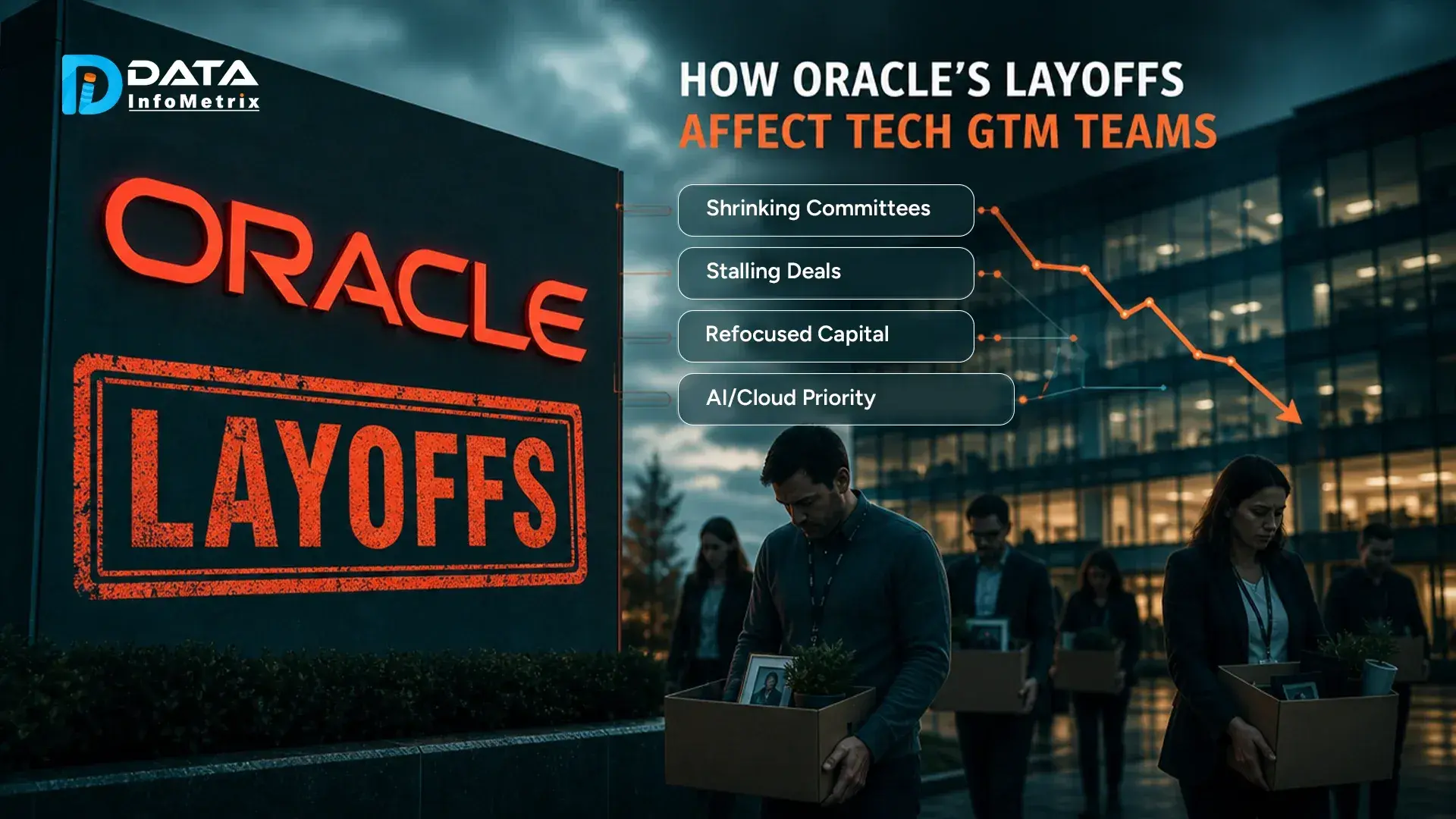
According to Business Insider, Oracle’s workforce fell from about 162,000 to 141,000 employees during the fiscal year ended May 31, a reduction of roughly 21,000 employees, or 13%. Oracle has also started another round of layoffs in September.
What makes this different? At the same time, Oracle is aggressively expanding its AI and cloud infrastructure business, securing $30 billion in new AI cloud contracts.
From my perspective, this changes the entire sales environment for every technology company trying to sell into Oracle.
Over the next 12 months, I'd say GTM teams can expect to see several major changes inside Oracle, each with different implications for pipeline, messaging, and deal strategy.
What I Believe GTM Teams Should Expect Next
Here’s what I believe GTM teams can anticipate in the coming days from Oracle:
Expect Smaller Buying Teams and Less Human Bandwidth
A 13% workforce reduction inevitably changes how work gets distributed.
Some decision-making roles will disappear. Others will be consolidated. Remaining employees will inherit larger scopes and have less time for exploratory vendor conversations.
Oracle's heavy investments in AI and cloud infrastructure suggest that automated agents could soon handle product evaluation and procurement.
Beyond longer response times and fewer meetings, this shift brings deeper hurdles for sales and marketing teams. This includes:
Exhausted buyers default to the status quo and reject vague pitches, while automated agents filter out anything missing strict ROI metrics. To win, your messaging must give machines hard technical evidence and humans immediate clarity.
Buying Priorities Will Follow Oracle’s New Capital Priorities
Oracle's recent signals reveal where the company is placing its bets.
Oracle is expanding data-center capacity, deploying hundreds of thousands of GPUs, and scaling its cloud infrastructure business to support AI workloads.
That creates an obvious implication for technology companies selling into Oracle.
Solutions directly connected to cloud infrastructure, AI workloads, data centers, networking, security, automation, reliability, and operational efficiency should have a stronger strategic context than solutions that simply improve a peripheral workflow.
This does not mean every non-AI vendor is automatically out.
It means the seller must explain why its product matters to the priorities Oracle is funding now.
Legacy-Oriented Sales Motions May Face More Friction
Oracle’s restructuring has not affected every part of the business equally.
The cuts have affected parts of product engineering and selected non-engineering functions, while Oracle continues expanding its cloud infrastructure business.
For vendors, this creates a practical problem.
A sales opportunity can still exist technically while becoming much harder to advance organizationally.
The person who owned a project may have left. A team may have been consolidated. A budget may have moved to another group.
This is where historical assumptions about Oracle’s internal decision-making structure can become obsolete surprisingly quickly.
Fewer Vendors May Get More Attention
I also expect restructuring will likely accelerate vendor consolidation.
When organizations reduce headcount while increasing infrastructure investment, operational simplicity becomes more valuable.
Oracle will have to balance an enormous AI infrastructure buildout with the complexity of managing suppliers, contracts, integrations, and support relationships.
For sellers, this means being another point solution may not be enough.
The stronger position is to show how your technology can eliminate operational complexity, consolidate capabilities, reduce risk, lower total cost, or support a strategic infrastructure program.
In other words, the size of the problem you solve matters more than the number of features you offer.
Sales Cycles May Lengthen Even as Deal Sizes Grow
Fewer stakeholders do not necessarily mean faster deals. When a purchase touches core AI infrastructure, security, architecture, legal, and procurement reviews can make evaluations more demanding.
At the same time, successful deals could become larger, shifting from departmental purchases to enterprise-wide deployments, multi-year agreements, or strategic capacity commitments.
The bar for proof will also rise. Vendors may need hyperscale references, proven performance, security validation, and clear ROI before Oracle is comfortable moving forward.
For GTM teams, that means preparing for longer evaluations, stronger scrutiny, and potentially much larger contracts.
Your Oracle Account Map May Need a Change
This is probably the biggest GTM lesson from the layoffs.
Do not treat Oracle as one account with one centralized buying motion.
Break the organization into business units, functions, technology priorities, locations, and decision-making groups.
Then identify where organizational change is happening and where Oracle is actively increasing investment.
For example, an account map should distinguish between teams connected to AI infrastructure expansion and teams operating in areas experiencing restructuring.
That changes the sales strategy from account-based selling to organization-aware selling.
What GTM Teams Should Do Now
A recession period doesn’t spell “disaster” for every technology vendor. In fact, such shifts often open new windows of opportunity.
Here’s what I’d advise go-to-market teams to follow for the next 12 months:
- Remap the account: Do not rely on contacts from six or twelve months ago. Validate roles, reporting structures, business units, and decision authority.
- Identify where budget is moving: Follow Oracle’s capital priorities, especially cloud infrastructure, AI, data centers, security, networking, automation, and operational efficiency.
- Shorten the sales story: Assume your buyer has less time. Lead with the business problem, measurable impact, implementation path, and risk reduction.
- Build for internal justification: Give your inside champion the material needed to defend the purchase to finance, procurement, technology leadership, and executive stakeholders.
- Monitor organizational signals continuously: Layoffs, leadership changes, data center expansions, partnerships, and investments all point to shifts in Oracle's buying power. This offers critical intent signals for GTM teams to uncover revenue opportunities.
Stop treating Oracle’s employee count as the account strategy. The important question is not how many people Oracle employs. It is which parts of Oracle are growing, which are being consolidated, where decision-making is moving, and what those teams now need to accomplish with fewer people.
Know Where Oracle’s Next Opportunities Are Emerging
Identify the right business units, technologies, buying signals, and decision-makers with fresh, ICP-focused account intelligence.
Build Your Oracle Account Map →The Opportunity Is in the Transformation
Oracle’s layoffs don't mean Oracle has stopped spending. The company’s latest investments show almost the opposite.
The more accurate interpretation is that Oracle is changing where it puts people and capital. That creates a different selling environment.
The goal goes far beyond simply tracking down displaced Oracle employees. It is to understand where Oracle’s organization is changing, where investment is accelerating, and which decision-makers now control the priorities that matter.
That is the difference between selling into an account and understanding an account.
And over the next 12 months, I believe that distinction will become increasingly important for every technology company trying to win Oracle as a customer.