





How High-Growth SaaS Companies Build Pipeline Around Technology Ecosystems
The targeting playbook that worked back in 2010 has quietly stopped working. Discover how high-growth SaaS teams move away from firmographics to build pipeline around technology ecosystems.
By Olivia Thomas, Director of Growth Marketing & Sales at Data InfoMetrix
TL;DR
I've spent the last twelve years building pipeline, first inside SaaS companies, later on the agency side working across B2B marketing services. Somewhere along the way I noticed the targeting playbook that worked back in 2010 has quietly stopped working for most teams. Firmographic filters, industry, headcount, revenue, region, still tell you what a company looks like on paper. They've never told you whether your product actually fits into what that company is already running.
The shift I keep seeing in the accounts that grow fastest is a move away from demographic targeting and toward technology ecosystem targeting. You map the platforms a prospect depends on, the tools it competes with, the systems it plugs into, and you build pipeline around that map instead of around a purchased list. There are five ecosystems worth knowing: Core Platform, Integration, Competitor, Complementary Technology, and Service.
None of it works without knowing, accurately, what a company is actually running. That's what Installed Base Data gives you. Layer intent signals on top and reps stop guessing which of a thousand "qualified" accounts to call first. Below I'll walk through where this framework came from, why it works, and where most teams still get it wrong.
The Filters We Grew Up On Are Losing Their Grip
I started out doing outbound for a mid-sized software company, back when a "qualified list" meant industry, headcount, and revenue band. Full stop, nothing more to it. And it worked, mostly because software stacks were simpler then and buying committees were smaller. You could call into a company, ask three discovery questions, and walk away with a decent read on what they had in place.
That confidence is gone now. According to a recent study by Forrester, in its Buyers' Journey Survey, 2025, the typical B2B purchase now pulls in an average of 13 stakeholders from inside the buying company and another 9 from outside it, with 73% of deals touching three or more departments. This seconded something I'd already noticed in my own client conversations over the past couple of years. Deals weren't dragging because buyers had gotten slower. They were dragging because there were simply more people in the room. A separate benchmark report by 6sense, in its 2024 Buyer Experience Report, found that the average buying group now sits at 11 people, the average cycle runs just over 11 months, and 81% of buyers already have a preferred vendor picked before they make first contact with a sales rep. That last number stopped me the first time I read it. Somewhere in the last decade, the simple deal disappeared, and so did most of the window sellers used to have to shape it.
What hasn't disappeared is the temptation to keep targeting the old way. I still see teams building lists off nothing more than "healthcare, 500 to 1,000 employees, US," then wondering why conversion keeps dropping. Two companies can match every one of those filters exactly and be in completely different buying situations. One runs a modern stack your product slots into cleanly. The other is three layers deep into something legacy that makes your integration a non-starter for the next eighteen months. Same firmographic profile. Nothing else in common.
Demographics describe a company. They were never built to tell you whether that company is ready.
If you've spent any real time in a growth marketing or sales leadership seat, I'd guess you've lived through some version of this already. Did your team ever hit every activity number on the board and still miss pipeline?
Section 1: What Traditional Prospecting Actually Costs You
I worked with a SaaS client a few years back whose SDR team was hitting activity targets every single week and missing pipeline targets every single quarter. When we dug into the list source, it was a generic contact database, filtered on the usual firmographic combo. Half the accounts had no technical reason to need the product at all.
That's the pattern I've watched play out at company after company. SDRs work a list where most accounts have no real fit, so every call starts from zero instead of from something specific. Campaigns get spread thin across accounts with almost nothing to personalize around beyond "you're in this industry." Sales cycles stretch because reps spend the first few calls just discovering what a prospect already has, rather than getting into the actual conversation. According to a recent study by Forrester, in its Demand, ABM, and Customer Marketing Survey, 2024, 56% of opportunities handed off from marketing to sales still fail to close, a number that hasn't meaningfully improved despite years of account-based marketing (ABM) targeting investment across the industry.
The common thread across all of it: firmographics answer who a company is and stop there. They were never designed to tell you whether a prospect has a technical reason to need you right now, which is the only question that actually predicts a closed deal.
I'm sure all of us have faced some version of this in our marketing and sales careers, watching a technically sound campaign underperform because the list underneath it was never built to answer the right question in the first place. That's the part of this job that never really changes, no matter how the tools around us do.
Section 2: Technology Ecosystems Are Where the Real Buying Signal Lives
Companies don't run software in isolation, not anymore. I've sat through enough discovery calls to know what a typical sales stack actually looks like these days. HubSpot feeding into Salesforce. Salesforce connected to Gong. ZoomInfo enriching records before they ever hit a rep's screen, Outreach firing off the sequences, Slack catching the alerts, and somewhere underneath all of it, AWS quietly running the whole thing.
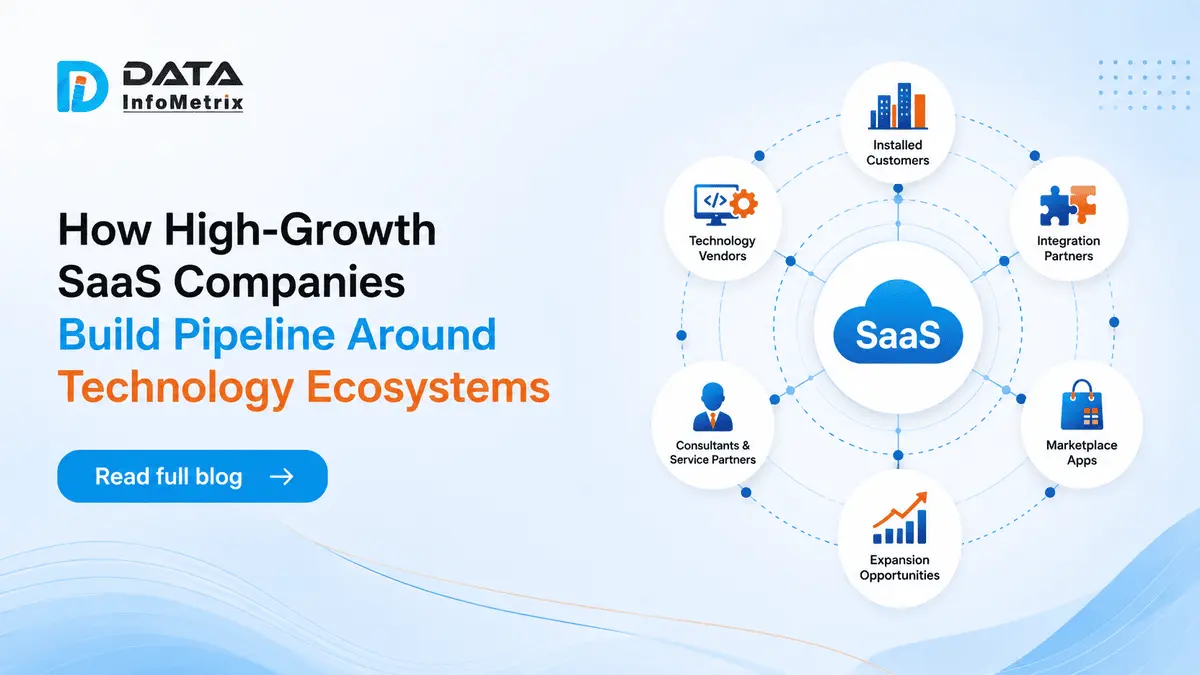
Every one of those connections creates a pocket of dependency. Companies cluster around a handful of core platforms and build outward in fairly predictable patterns, because switching one piece of a connected stack has real cost attached to it, and most teams know that better than anyone tells them. Zoom out to the market level and the same shape repeats itself. A vendor sits at the center, surrounded by its installed customers, then integration partners, then consultants, then marketplace apps, then adjacent technologies, then whatever expansion opportunities fall out of that whole structure.
Each vendor is effectively sitting at the center of a ready-made market. I think this is the piece most GTM teams miss entirely. The real targeting question was never "who exists out there." It's "where does my product actually sit inside someone else's ecosystem, and who's already standing in that spot."
Section 3: Five Ecosystems Worth Mapping
Core Platform Ecosystem
These are companies built around one dominant system, Salesforce, Microsoft, SAP, Oracle, AWS, Google Cloud, take your pick. Once that core is set, everything else in the stack gets chosen to work around it, not the other way around.
Integration Ecosystem
Companies actively wiring integrations into platforms like HubSpot, Snowflake, ServiceNow, NetSuite, Shopify. If a company is putting in that kind of effort to connect its tools, that tells you something. It's treating its stack as a living thing, not something it set up once and forgot about. You can read more about building GTM plays for integration ecosystems on our platform.
Competitor Ecosystem
Accounts sitting on a rival platform right now. This is usually the highest-intent segment on the whole list, in my experience, and it's not close. These companies have already proven they buy in your category. They just bought from someone else, which means most of the education work is already done for you. Check out our detailed guide on competitor conquesting campaigns for exact playbooks.
Complementary Technology Ecosystem
Tools that sit in the same workflow without going head to head. Picture CRM feeding into marketing automation, then sales engagement, then conversation intelligence, then customer success, each one handing off to the next. A company sitting on one of those layers is a reasonable bet for whatever sits next to it.
Service Ecosystem
Implementation partners, consultants, MSPs, systems integrators, VARs. This is the one that drives referral pipeline and co-sell relationships more than it drives direct demand, and honestly it's the ecosystem I see teams overlook the most. Usually because it lives over in the partnerships org and never actually touches the demand gen calendar.
None of these categories are exotic on their own. What changes when you map a market against them is that you now know why a company is likely to buy, instead of just guessing that it theoretically might.
Section 4: How This Actually Gets Built
Start with your own product. What integrates with it? What does it depend on? What competes with it directly? Simple enough questions on paper. I've sat through this exercise with a handful of clients now, and the surprising part every time is how rarely marketing and sales have actually written the answers down in one place they both use.
From there, map the ecosystem into real categories: installed customers, competitors, partners, marketplace apps, consultants, communities, agencies. Each one becomes its own segment rather than one undifferentiated list that gets the same email three times over.
Then flip your prioritization logic. Instead of "manufacturing, 500 employees, US," you're working from "runs HubSpot," "migrating off Marketo," "on Snowflake," "on Epic," "on Workday." These are technology signals, and they tell you something concrete about fit and timing. Company size mostly doesn't.
Last comes the campaign build, and this is where I've watched the most good work get flattened. One ecosystem should produce several distinct plays, not one. A migration message and an expansion message are not the same pitch with the logo swapped out.
Section 5: Matching the Play to the Segment
| Target | Campaign |
|---|---|
| Competitor users | Migration campaign |
| Integration users | Co-selling |
| ERP customers | Add-on sales for ERP users |
| Marketplace customers | Cross-sell |
| Existing technology users | Expansion |
| Legacy software users | Modernization |
| Healthcare EHR users | Healthcare compliance & EHR solutions |
| Cloud platform users | Cloud security & cybersecurity products |
Every row on that table is a different reason someone is ready to talk to you. I've watched teams send a modernization pitch to a competitor-conquesting segment because it was easier to just reuse the copy. It reads exactly as generic as you'd expect it to.
Section 6: Where I See Teams Trip Up, Over and Over
Buying a generic database and calling it targeting. That's not targeting, that's just a list of unknowns wearing job titles.
Weighting industry over technology, because industry feels like it should matter more. It tells you something about regulatory context, sure. It rarely tells you whether your product actually fits.
Ignoring the integration ecosystem entirely, which is a shame. In my experience integration partners and marketplace participants are consistently one of the highest-intent groups in the market, and almost nobody targets them on purpose.
Running partnerships and demand gen as separate functions, with separate spreadsheets and separate goals, when they're really answering the same underlying question from two different directions.
And the one I see most often, working off technology data that's a year or two stale. Stacks change fast. Tools get swapped, migrated, or quietly deprecated within months, not years. A snapshot pulled eighteen months ago isn't a reliable picture of what a company runs today, and in my view, stale technology data isn't meaningfully better than no technology data at all.
Does any of this sound familiar? If you're running growth or revenue for a SaaS company right now, I'd be surprised if you haven't run into at least two of these five in the last year.
Section 7: Where Installed Base Intelligence Fits
Not every company on Salesforce needs your product. Obviously not. But every real opportunity I've ever worked started the same way, with knowing which technologies a company runs, what sits alongside them, where the migration gaps are, which integrations actually matter, and which ecosystem the account belongs to.
That's the layer a generic database simply cannot provide, because it was built around company records, not technology relationships. This is where Installed Base Intelligence earns its keep, knowing accurately and currently who's running what, and it's what turns an ecosystem map from a whiteboard exercise into something a rep can actually work a list against.
At DataInfoMetrix, this is the whole premise of what we build. A generic list can confirm a company exists and roughly what size it is. It can't tell you what that company is actually running, whether the data is still accurate, or whether it was ever built around your specific ICP in the first place. We build every dataset around the client's ICP from the start, rather than filtering a static, pre-built database, because a loosely matched or outdated list defeats the entire purpose before the first email even goes out. Every record gets sourced fresh and passed through SMTP data enrichment & validation checks before it reaches a client. Technology accuracy doesn't count for much if half the contacts bounce anyway.
Section 8: Installed Base Data Plus Intent Data
These two signals answer different questions, and I've seen plenty of teams lean on just one, then wonder why results plateau.
Installed base data tells you whether a company can buy, whether your product is technically relevant to what they're already running. Intent data tells you whether they're actively researching right now. A company can be a perfect technical fit and show zero research activity. Another can show heavy intent signals while running a stack that makes your product a non-starter. Either signal alone produces false positives.
| Signal | What it tells you |
|---|---|
| Firmographics | Who they are |
| Installed Base Data | What they use |
| Intent Data | Real-time buyer intent signals |
| Engagement Data | How they're interacting |
| CRM Data | Your existing relationship |
The sequencing matters here. Installed base data should qualify the universe first, narrowing it to accounts that could plausibly buy, before intent data tells you which of those are in-market right now. According to a recent study by Gartner, based on its original Digital B2B Buyer Survey, B2B buyers spend only about 17% of their total purchase journey meeting with potential suppliers, and when a buyer is weighing multiple vendors, that already-thin 17% gets split further, down to roughly 5 to 6% of their time per supplier. That finding matched what I'd already been telling clients for years. By the time your rep gets a call back, the buyer has usually made up most of their mind without you in the room. Apply intent signals to an unqualified, technology-blind list and all you've done is reach the wrong accounts faster.
Section 9: A Maturity Model I Use With Clients
| Level | GTM Approach |
|---|---|
| Level 1 | Industry-based targeting |
| Level 2 | Firmographic segmentation |
| Level 3 | Technographic filtering |
| Level 4 | Installed Base Intelligence |
| Level 5 | Installed Base + Intent + AI-driven prioritization |
Levels 1 and 2 are broad-strokes targeting, industry or firmographic slices, with waste priced in as the cost of reaching volume. Level 3 usually means filtering on general technographic categories like "uses marketing automation," and often that data was sourced loosely and hasn't been refreshed in a while. Level 4 is where teams start building campaigns around verified, current, ICP-specific installed base data, not just "uses a CRM" but which one specifically, and what that actually implies about fit. Level 5 layers intent and AI-driven prioritization on top, so reps end up spending their time on accounts that are both qualified and actively in-market.
Most of the teams I talk to are still sitting at Level 2 or 3. That's not a criticism, it's just where the market is right now. It's also exactly why the plays in Section 5 still outperform as well as they do. Most competitors in any given category haven't made this shift yet.
Where would you place your own team on that list right now? I ask clients this fairly often, and most people know the honest answer before I even finish the question.
Where I'd Start If I Were You
Pipeline doesn't grow just because you're reaching more people. It grows when you're reaching the right people, companies where your product genuinely fits inside a stack they're already running.
Technology ecosystems surface compatibility, partnership angles, migration paths, and expansion opportunities that a firmographic list was never built to find. I don't say that as a knock on firmographics. They're just answering a different, narrower question than the one that actually predicts whether a deal closes.
Every team I've helped make this shift ends up spending less time chasing accounts that were never going to close and more time in front of buyers already sitting in the environment where the product actually works. Over time that shows up as shorter cycles, better conversion, and pipeline that's already qualified before the first email goes out. If you want to talk through what your own technology ecosystem map might look like, talk to our team at Data InfoMetrix — that's a conversation we have almost every week, and it's usually the most useful hour a GTM team spends all quarter.
FAQ
What is technology ecosystem marketing?
A GTM approach built around what a company already runs, its core platforms, integrations, competitors, and adjacent tools, rather than industry, size, or geography as the primary filter.
What is Installed Base Data?
Data that identifies specific companies using a given piece of software, platform, or system, which organizations run Salesforce, Epic, AWS, or SAP, for example. Also called a Technology Users List. Built around verified, current usage rather than general firmographic attributes.
How is this different from a generic B2B contact database?
A generic database describes a company, industry, size, location, and hands you contact records. Installed Base Data describes what that company actually runs, which in my experience is a far stronger predictor of fit and timing than firmographics ever were.
How is it different from "technographic" data?
"Technographic" tends to get used loosely to describe broad, static technology categories pulled from public signals. Installed Base Data, done properly, is sourced and verified around a specific buyer's ICP, refreshed on demand, and checked for deliverability, not pulled once from a stale generic set and left as-is.
Do you still need intent data if you already have installed base data?
Yes. They answer different questions. Installed base data tells you who's technically capable of buying, intent data tells you who's actively researching. Together they narrow the list much further than either does alone.
What are the most common use cases?
Competitor conquesting, technology migration campaigns, integration ecosystem targeting, marketplace and add-on expansion, targeting implementation and advisory partners, market research recruitment, event attendee acquisition, and custom technology audience sourcing.
Where should a team start if they're doing firmographic-only targeting today?
Map your product's ecosystem first, core platform, integrations, competitors, complementary tools, service partners, then swap technology signals in for demographic filters on your next campaign segment. That one change tends to move a team from Level 2 to Level 3 or 4 fairly quickly.
Why does data freshness matter this much?
Because stacks change constantly, tools get swapped or migrated within months, not years. A technology list built once and left alone is wrong for a meaningful share of accounts by the time it's actually used, which undercuts the entire premise of targeting on technology in the first place.
 Written byOlivia ThomasDirector of Growth Marketing & Sales
Related articles
Salesforce Is Buying Braze. What Happens to 2,770 Customers in the Meantime?
Salesforce announced an agreement to acquire Braze for $5.66B. Explore what happens to 2,770 Braze customers, why ownership changes reopen tech renewals, and how GTM teams can navigate the window.
Olivia Thomas · 6 min read
Inside the 2026 Executive Research Series: Announcing 4 Comprehensive eBooks and 4 Empirical Whitepapers on B2B Installed Base Intelligence
Data InfoMetrix releases its landmark 2026 Executive Research Series: 4 tactical eBooks and 4 empirical Whitepapers providing research-backed benchmarks on technographic data decay, legacy migration cycles, and account selection.
Olivia Thomas · 9 min read
What Oracle’s 2026 Layoffs Mean for GTM Teams
Explore how Oracle’s 2026 layoffs reshape buying teams, capital priorities, sales cycles, and vendor strategies for technology companies selling to Oracle.
Olivia Thomas · 6 min read