





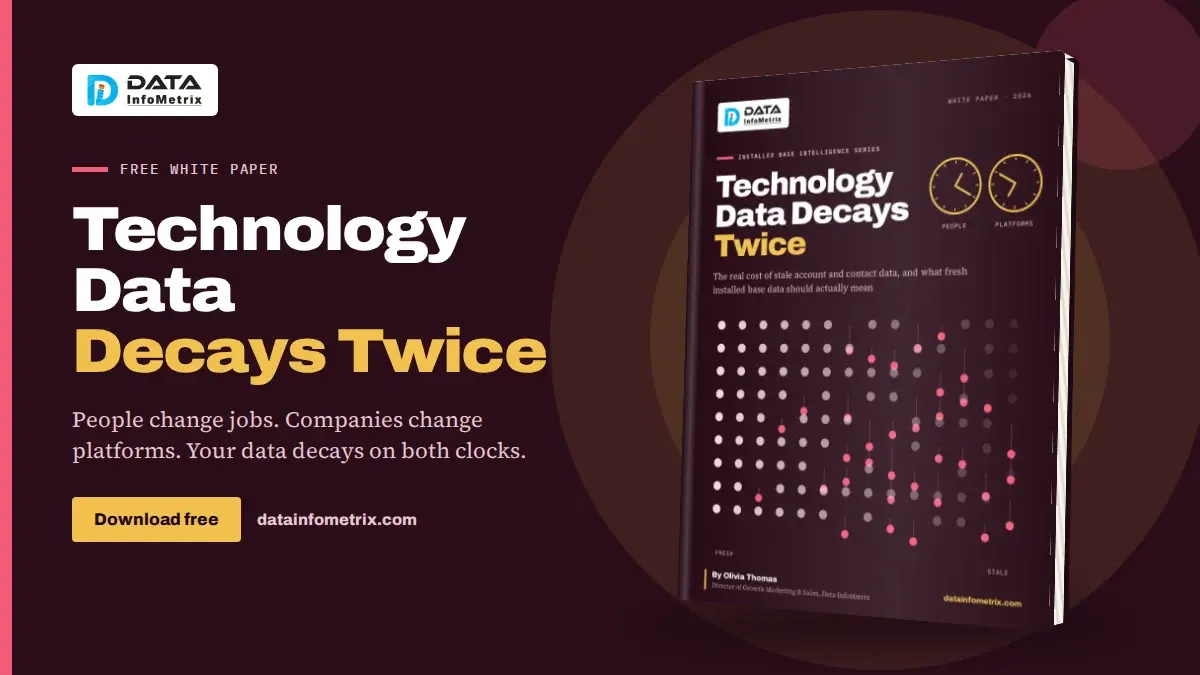
Technology Data Decays Twice: The Real Cost of Stale Account and Contact Data
The real cost of stale account and contact data, and what fresh installed base data should actually mean.
 Olivia ThomasDirector of Growth Marketing & Sales, Data InfoMetrix
Download the free whitepaper
Enter your details to receive the complete 18-page PDF in your inbox and start reading right away.
What this whitepaper covers
Most B2B data goes stale once. Technology data goes stale twice: first, when people change jobs, and second, when companies change their underlying software platforms. While contact decay is widely recognized, the silent clock of technographic decay is rarely accounted for—and it quietly destroys B2B campaign ROI.
In this eye-opening 18-page technical whitepaper, Olivia Thomas examines the compounding impact of dual-vector data decay. Using US Bureau of Labor Statistics tenure numbers and empirical B2B software churn metrics, she demonstrates how a standard static database loses up to 35% of its accuracy within just 12 months.
Explore the real operational costs of stale data—from burnt domain reputations and deliverability blacklists to rep demoralization—and discover the Data Freshness Scorecard, optimal refresh cadences by use case, and internal hygiene best practices.
Key findings
The Two Clocks of B2B Decay
Clock One: People move roles, companies, and departments. Clock Two: Stacks migrate, renew, and consolidate.
The Deliverability Penalty
How sending outbound emails to stale contact data triggers spam filters, ESP throttling, and domain blacklisting.
The Data Freshness Scorecard
An objective grading rubric across Verification Timestamp, Contact Recency, Method Transparency, and Replacement SLAs.
Refresh Cadence by Use Case
Optimal data validation frequency for cold outbound, ABM ad targeting, CRM enrichment, and territory planning.
Inside the whitepaper
01People Move: Contact Data Decay
Analysis of labor market mobility, declining employee tenure (3.5 years), and the mathematics of contact rot.
02Stacks Move: Technology Data Decay
How cloud SaaS migration velocity, contract renewals, and vendor consolidation obsolete static lists.
03The Compounding Effect
Mathematical modeling of dual-vector decay showing why static databases lose over a third of their accuracy annually.
04What Bad Data Costs
Financial accounting of wasted SDR salaries, burned marketing budgets, and lost enterprise revenue opportunities.
05The Deliverability Penalty
How major ESPs (Google Workspace, Microsoft 365) enforce strict spam thresholds (0.1% complaint / 2% bounce).
06Where Stale Technology Data Hurts Most
Specific campaign scenarios where outdated technographics produce catastrophic embarrassment and deal loss.
07What "Fresh" Should Actually Mean
Deconstructing vendor marketing claims and defining technical standards for legitimate data freshness.
08Refresh Cadence by Use Case
Tailoring data validation schedules to specific GTM motions (Cold Outbound vs ABM vs Inbound Enrichment).
09The Data Freshness Scorecard
Self-audit framework to evaluate internal CRM database health and assess external data vendors.
10How Data InfoMetrix Keeps Data Fresh
Data InfoMetrix’s zero-stale-catalog build-to-order model, 5-stage SMTP verification, and 99% deliverability SLA.
Who should read it
RevOps & Marketing Operations Leaders
Audit CRM health, prevent domain blacklisting, and implement automated data enrichment workflows.
VPs of Demand Generation & Outbound
Protect campaign deliverability and ensure SDR teams execute outreach against confirmed active software users.
Sales Development (SDR) Managers
Eliminate wasted rep prospecting hours and boost connect rates by providing verified direct dials.
Chief Information & Security Officers (CIO/CISO)
Ensure external B2B intelligence vendors comply with GDPR, CCPA, and data privacy governance.
About the authorOlivia ThomasOlivia Thomas heads growth marketing and sales intelligence strategy at Data InfoMetrix, partnering with enterprise software vendors, high-growth SaaS scaleups, and systems integrators to build precision installed-base audiences that drive predictable pipeline.Questions, answered
What does "technology data decays twice" mean?
It means B2B technology datasets degrade along two separate dimensions: contact turnover (people changing jobs) and technographic turnover (companies switching, upgrading, or retiring software applications).
How quickly does B2B contact data become inaccurate?
Industry research from HubSpot and MarketingSherpa shows contact data decays at roughly 2.1% per month. Over 12 months, more than 22% of emails and phone numbers become obsolete.
How does Data InfoMetrix prevent data decay?
Rather than selling static database dumps from a frozen catalog, Data InfoMetrix builds every audience fresh upon client order, running real-time 5-stage SMTP handshakes and telemetry re-verification within a 30-day window.
Put the research to work
Get the PDF free, or ask us for a sample of the installed base it describes.
More whitepapers

The Migration Wave
Mapping the enterprise technology transitions that will create B2B pipeline through 2030.

The Compatibility Economy
How integration requirements now decide B2B software deals, and why the stack a prospect runs should decide who we target.

Ecosystem-Led Growth
How partnerships, alliances, and marketplace teams turn installed base intelligence into co-sell pipeline.