





How Data InfoMetrix Builds and Delivers a Technology Users Email List
Learn how Data InfoMetrix builds technology users email lists using technographics, business signals, verification, and market intelligence.
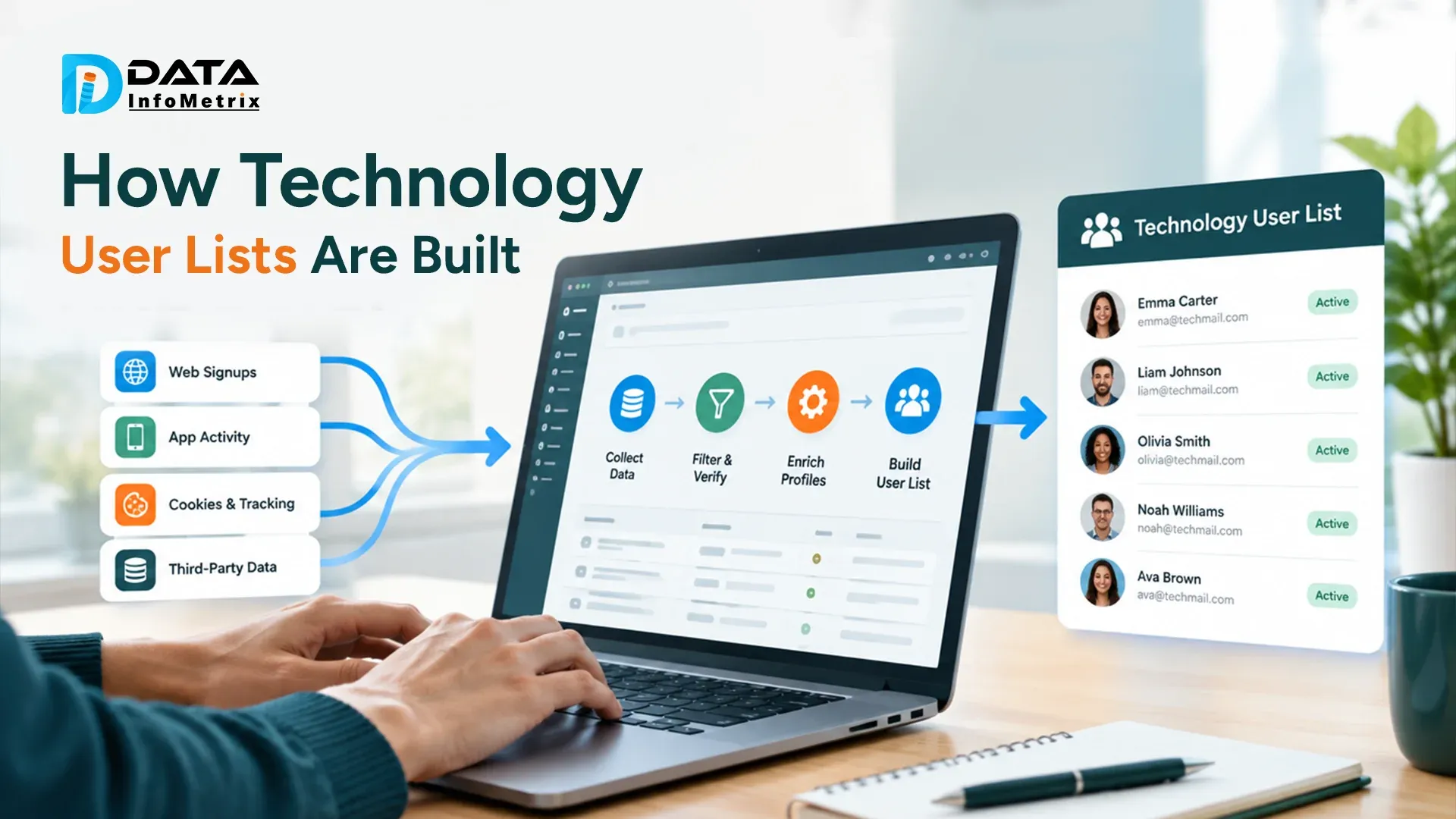
By Olivia Thomas, Director of Growth Marketing & Sales at Data InfoMetrix
Last quarter, an enterprise software company in Texas invested $200 in a “sales-ready” contact database.
It looked promising: thousands of contacts, verified email addresses, job titles, and target accounts.
The problem surfaced when outreach began. Some contacts had left their companies, others no longer managed the technology they were associated with, and several target accounts had already migrated to competing platforms.
What looked like a qualified market was actually a snapshot of one that existed months earlier.
This decay is a structural reality in B2B data. Even Landbase’s recent report shows that B2B contact data decays at roughly 2.1% per month and 22.5% annually.
If you sit on a static list for six months, more than 12% of your records can already be outdated.
I see this challenge frequently in B2B marketing and sales. A contact can be valid, an account can match the ICP, and an email can be deliverable. However, the record can still be commercially irrelevant because the technology relationship or business context has changed.
That is why Data InfoMetrix builds a technology user email list with relevant context, rather than simply providing a technology match and contact information.
Technology Data Is Only the Starting Point
Most traditional databases are built around information collected at a specific point in time. They can identify a company, a contact, an industry, and sometimes a technology.
For competitor conquesting, migration campaigns, ABM programs, integration partnerships, and market expansion initiatives, that is rarely enough.
A technology users list should answer more than who works at a company. It should help identify which companies currently use the technology, who influences technology decisions, and whether there is a reason to engage that account now.
At Data InfoMetrix, we start by validating the technology relationship itself.
We look beyond individual contacts and examine the broader technology environment surrounding an account. Understanding how technologies coexist across an organization often reveals far more opportunity than a simple technology filter.
Technology Stacks Matter More Than Individual Technologies
Many legacy providers still treat technographics as a single-variable filter: Salesforce users, AWS users, SAP users, and so on.
Enterprise technology environments rarely work that way.
Organizations operate across interconnected platforms, cloud environments, business applications, security tools, and data systems. For integration, migration, and modernization providers, the opportunity often exists at the intersection of those technologies.
- A migration provider may need a list of companies running Oracle ERP and Azure.
- An integration company may target organizations using Salesforce, AWS, and SAP together.
In these cases, the technology combination becomes part of the audience definition.
Traditional databases often struggle to identify these relationships accurately.
At Data InfoMetrix, we analyze technology ecosystems rather than isolated technologies, helping clients build a more precise technology customer list based on how platforms coexist across the enterprise.
This approach creates audiences that align more closely with real-world buying scenarios instead of relying on broad technology categories.
Turning Technology Intelligence Into Commercial Opportunity
Technology identification alone does not create pipeline.
Many providers use automated extraction methods to collect names, titles, domains, and publicly available information at scale. The result may resemble a technology users database, but volume does not automatically create relevance.
- A contact who recently changed jobs is not a prospect.
- A company that replaced the target technology may no longer represent an opportunity.
- A technology match without current context can create what I call a ghost lead: a record that appears valuable in a spreadsheet but has little practical value for sales and marketing teams.
That is why technology usage should be evaluated alongside other signals that help explain what is happening inside an account.
At Data InfoMetrix, we combine technographics with firmographics, decision-maker intelligence, and business signals such as hiring activity, leadership changes, expansion initiatives, acquisitions, funding events, and technology transitions.
Technology usage becomes the starting point of account research, not the final answer.
Building Accounts Around the Client’s Objective
One of the biggest differences in our process is that we do not begin with a predefined database.
Every project starts with the client’s commercial objective.
- A software company targeting users of a competing platform requires a different audience than an integration provider seeking complementary technology stacks.
- A migration services firm entering the U.S. market requires different account criteria than an organization running an ABM campaign.
The audience is built around the objective, not the other way around.
Technology requirements, industry segments, company size, geography, seniority levels, business conditions, and account priorities are all evaluated as part of the research process.
This is why I do not view a technology customer list as a static product. It is a research-driven account list designed for a specific sales or marketing outcome.
Verification Happens at Multiple Levels
Building a technology users email list does not end with identifying companies and contacts.
Verification is equally important.
At Data InfoMetrix, we validate contact quality through email validation, SMTP verification, bounce reduction processes, spam trap screening, and additional quality-control checks.
We also verify whether the contact, role, company, and technology relationship still make sense together.
People change jobs, departments evolve, organizations restructure, and responsibilities shift.
A technology match has limited value if the associated decision-maker is no longer involved in the buying process.
Our goal is to deliver accounts that sales and marketing teams can confidently use, not spreadsheets that contain large volumes of records.
Tiffany Jones, Marketing Director at Data InfoMetrix, explains our approach to verification:
“We don’t view verification as a one-time quality check. It is an ongoing process of validating contacts, companies, and technology relationships against changing market conditions.
The goal is to give our clients a current view of the market, not simply a file of contacts that was accurate when it was created.”
Data InfoMetrix Doesn’t Just Deliver a List. It Delivers Market Intelligence.
When a company asks for a technology users email list, the first question should not be how many contacts they need.
The first question should be what they are trying to achieve.
- Are they targeting competitor customers?
- Identifying migration opportunities?
- Building integration partnerships?
- Expanding into a new market?
- Supporting an ABM strategy?
The answer determines how the account should be built.
At Data InfoMetrix, we combine technographic intelligence, business signals, firmographics, decision-maker data, and verification processes to create accounts aligned with specific commercial objectives.
The result is more than just a list of contacts.
It is a researched view of the market that helps GTM teams identify the right accounts, reach the right decision-makers, and focus on opportunities that are more likely to convert.
That is the difference between buying a database and building market intelligence.
 Written byOlivia ThomasDirector of Growth Marketing & Sales
Related articles
B2B Buying Signals Tech Sales Teams Need to Know in 2026
Learn which B2B buying signals actually predict purchase intent in 2026, from tech stack changes to procurement activity, and how to act on them fast.
Olivia Thomas · 10 min read
Why We Built MedicalProspects: The Problem With Generic Healthcare Data
When ZoomInfo, Apollo, and Lusha Can't Get You to the Right Room, You Need a Specialist For over ten years, DataInfoMetrix has helped B2B teams build pipeline.…
 John Britton · 4 min read
What is B2B Marketing? A Complete Guide in 2025
Introduction to B2B Marketing Evolution The B2B buying process now typically begins with a referral or an online search, with over 84% of decision-makers…
John Britton · 11 min read