





B2B Buying Signals Tech Sales Teams Need to Know in 2026
Learn which B2B buying signals actually predict purchase intent in 2026, from tech stack changes to procurement activity, and how to act on them fast.
I keep hearing one question from sales leaders.
I've lost count of the calls I've had with sales leaders and growth heads this year. Different titles, different industries, same question: "Which signals actually tell my team to call now?"
Some swear by website activity. A visit here, a content download there, and they're convinced it's go time. Others think that's far too weak a foundation to build a pipeline on.
Then there's the crowd watching new executive hires, funding rounds, and technology changes instead. And a growing group is glued to competitor research, migration chatter, and AI adoption patterns, betting that's where the real story lives.
Here's my honest take after years of watching these bets play out. The strongest signal rarely happens on a single event. It's a pattern, several small things pointing in the same direction at once, and Forrester’s 2025 Buyers’ Journey Survey backs this up: the average B2B buying committee now includes 10 to 13 decision-makers, which means one lonely signal was never going to tell the whole story anyway.
That idea is the thread running through everything below.
The Buying Signals I Trust Most, and the Ones I Treat Carefully
Not every signal deserves the same weight, so let's sort them honestly.
| Buyers Activity | What It Means | Signal Strength |
|---|---|---|
| Tech replacement, migration, active research, relevant hiring | Indicates active change or a likely business need | Strong |
| Leadership change, funding, expansion, new department | Indicates a potential project or shifting priority | Medium |
| Single page visit, generic content download, social engagement | Interesting, but not enough by itself | Weak Alone |
Don't confuse activity with intent. A page visit tells you someone was curious for thirty seconds, not that a budget is being drawn up, and mixing those two up is how good SDRs waste good hours.
That distinction sets up everything you're about to read.
10 B2B Buying Signals Tech Sales Teams Should Watch in 2026
For every signal, ask four questions. What's happening, why it matters, who should act, and what should they do next? That's what turns a list into marketing intelligence instead of trivia.
1. A Company Changes Its Technology Stack
New installations, replacements, removals, migrations, and CRM or ERP swaps all count here. This is one of the loudest signals a company can send without saying a word.
Watching CRM users move is a great place to start, since a switch usually means budget, urgency, and a fresh set of priorities all at once. A company switching from HubSpot CRM to Salesforce CRM, or from Zoho CRM to a more enterprise-grade CRM, is telling you exactly where to knock.
Here's the trick most teams miss: check how long the new tool has been live. A stack change within a company in the last 90 days usually means the buyer is still stitching integrations together, which is precisely when a complementary tool becomes an easy yes instead of a hard no.
2. Hiring for the Problem You Solve
Job posts are basically companies thinking out loud. Are you selling cybersecurity? Watch for security engineers and SOC analysts. Selling RevOps software? Watch for Salesforce and marketing ops hires.
Hiring isn't just a growth signal. It can reveal the project before it's ever publicly announced, giving you a head start most competitors won't have.
The tip here is velocity, not headcount. One open role is a maybe; three related roles opened in the same month signal a project with an approved budget, so track the pace of hiring, not just the job titles.
3. A New CIO, CTO, CMO, CRO, or VP Joins
New leaders love resetting priorities, and that's exactly why this matters. But don't stop at "new executive equals buy."
The real formula is a new leader + a relevant initiative. Pair that arrival with what the executive championed at their last company, and you've got a lead worth calling.
Most new leaders make their first real vendor decisions within the first 90 to 100 days, often called the "new leader honeymoon window," so that's your realistic window to reach out, not month six when priorities have already hardened.
For example, if a new CRO previously drove a Salesforce rollout at their last company, don't pitch generically. Reference that exact signal and watch the reply rate change.
4. Competitor or Alternative Research
Watch for searches like "[Competitor] alternatives," comparison content, and review site activity. A prospect researching your category is interesting.
A prospect researching your competitor by name is actionable, and that's the difference between browsing and shopping.
Here's the trick: you don't need to stalk every prospect's browser history to know this. B2B data intelligence provider already tracks which companies are reading comparison content, visiting review sites like G2, and searching competitor terms, and then provides you with that account list directly.
Pull that report weekly, and you'll know exactly which objection to pre-empt in your first email rather than writing a generic opener.
5. Multiple People From the Same Account Start Researching
One person reading your blog can be noise. But when an IT manager reads technical content, a VP checks pricing, and a finance lead reviews implementation details, that's a chorus, not a solo act.
That's buying-group activity, not individual activity, and it deserves a very different response than a single email. Seeing three or more stakeholders from an account light up in the same two-week window is often a stronger indicator than any single title change.
6. Funding, Expansion, or a New Business Move
New funding, acquisitions, geographic expansion, and new product launches all create fresh technology requirements almost by default. But here's the part most teams skip: funding alone isn’t purchase intent, so don't treat it like a green light on its own.
It becomes powerful only when paired with a second signal. Funding + rapid hiring + new cloud infrastructure is a genuinely strong story, while funding sitting alone in a press release is just news.
The move is to set alerts for funding events, then check hiring and technology activity for the same account 30 to 60 days later, since that's usually when the actual buying motion starts.
7. AI Search Is Changing What Buyers Ask
Buyers increasingly ask ChatGPT and AI search tools before they ever fill out a form on your site. G2 reports that 79% of software buyers say AI search has reshaped how they research, and enterprise buyers now rank review sites and AI search among their top sources.
That means your website analytics may no longer show the full research journey. Buyers are also active on review sites, industry communities, and analyst content, so if you're only watching your own site traffic, you're reading half the story and calling it the whole book.
A quick tip worth stealing: check whether your product even gets mentioned when someone asks an AI tool to compare vendors in your category. If it doesn't, you don’t have a buying signal problem; you’ve a visibility problem, and that’s what needs fixing first.
8. Operational Pain Becomes Visible
Rapid headcount growth, rising support volume, security incidents, compliance pressure. A company doesn't always announce that it wants to buy software.
Sometimes the problem announces it for them, loudly, through the cracks in their current systems. Glassdoor reviews and job postings for "firefighting" style roles, such as a sudden opening for a dedicated “Ops Troubleshooter,” are an underused source here.
Employees often complain about the exact tooling gaps your product solves, months before procurement ever gets involved.
9. Budget, Procurement, or Commercial Activity Appears
This is a signal that a lot of buying-signal content quietly skips, and it shouldn't. RFP activity, procurement announcements, vendor evaluations, new procurement hires, and active contracting work all sit much closer to the actual buying event than a whitepaper download ever will.
For tech sales and revenue teams, this is considerably more actionable than a content download, because the company has already decided to spend money somewhere. Your job shifts from creating interest to earning consideration.
One practical tip: procurement-related job postings, such as "Vendor Management Specialist" or "Procurement Analyst," often go live weeks before an RFP does. Treat those postings as an early warning system, not just a hiring update.
10. The Signal Stack: When It All Converges
Here's where it gets interesting. Instead of "Company X downloaded an ebook," picture this: a new CTO, five open cloud engineering roles, active AWS expansion, competitor research, and three IT stakeholders quietly researching security tools.
That's not a hunch anymore; that's a pattern you can act on with confidence. One signal creates a hypothesis. Several signals pointing the same way create a high-priority account, and this is the single biggest mindset shift most B2B teams need to make in 2026.
Which Signals Should SDRs, Marketers, and Growth Teams Prioritize?
Ten signals are a lot to track, and no single person on your team needs to watch all of them. An SDR cares about a different slice of the picture than a CMO does, and that's exactly the point.
The same underlying data can mean "call this account today" to one team and "shift budget toward this market" to another. Here's how each role should read it.
| Team | Signals to Prioritize | What to Do |
|---|---|---|
| SDRs | Tech changes, competitor research, hiring, leadership changes | Prioritize accounts and personalize outreach |
| Lead Gen | Firmographic + technographic + hiring + intent | Build higher-quality prospect segments |
| Growth Teams | Tech adoption, expansion, funding, market changes | Find emerging markets and whitespace |
| Marketing | Search behavior, content engagement, competitor research, AI discovery | Create content around real buyer questions |
| RevOps | Signal combinations and recency | Develop intent-based tiering and routing rules |
| Sales Leaders | Account-level signal density | Reallocate SDR effort toward high-potential accounts |
| C-level/VPs | Market-level signal trends | Identify competitive gaps and new revenue opportunities |
Once you know which signals matter to your seat, the next question is what to do with them.
Build a 2026 Buying Signal Workflow
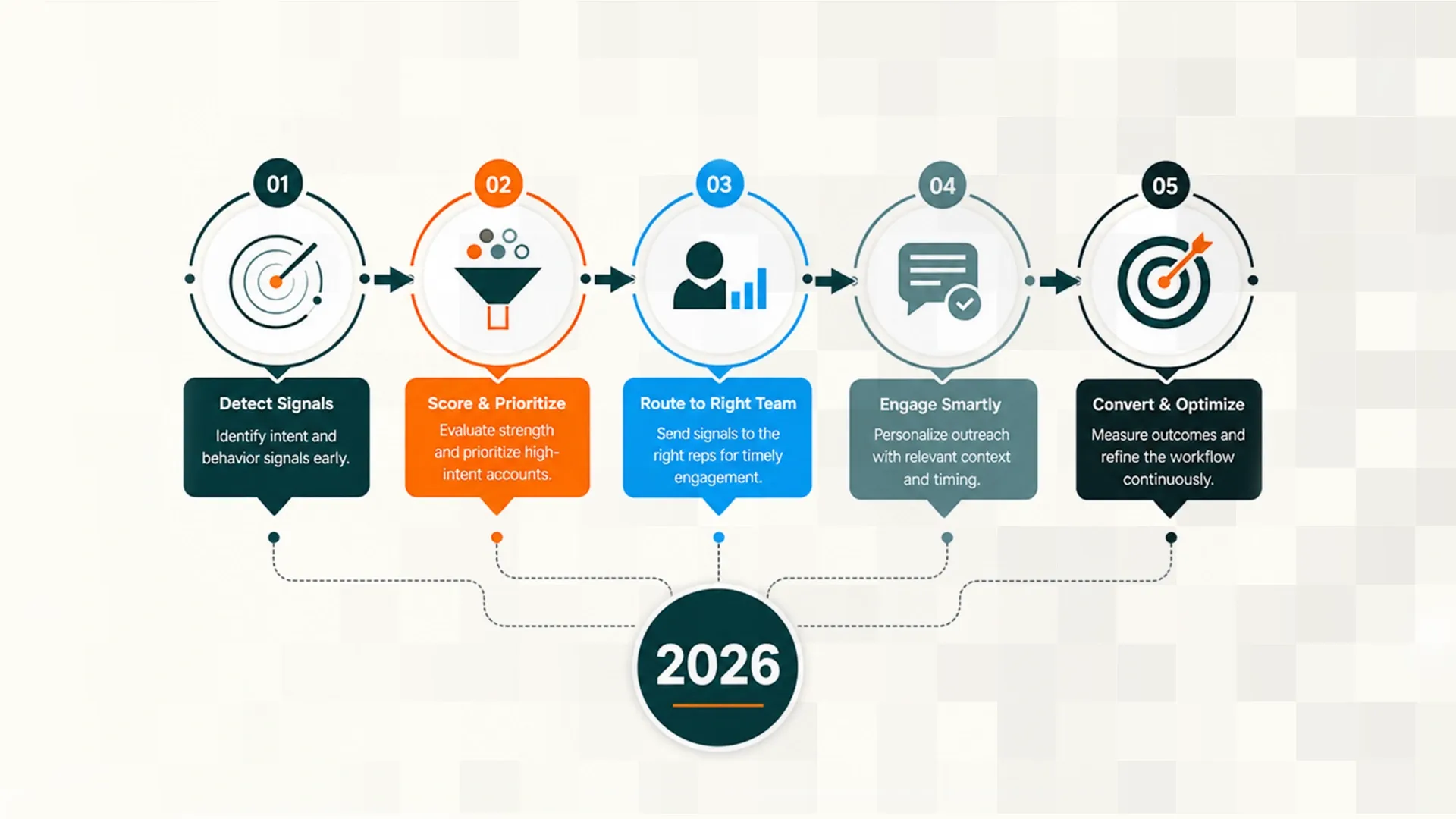
Turn signals into a system, not a scramble. Find accounts matching your ICP, match them with technographic insights and firmographic data, and detect hiring, research, leadership, and expansion activity in real time.
Then prioritize by signal strength, recency, and signals stacking up on one account. Because here's the thing worth repeating: a buying signal is not a lead score; it's context for a business decision, and "account scored 82" will never beat "this account uses Salesforce CRM, just hired a VP of RevOps, and is actively researching alternatives."
Finally, act. Reach the right decision-maker with a message tied directly to what changed, so your SDR has an actual reason to pick up the phone, rather than a number to dial.
Turn Signals Into Sales Opportunities
Your sales team doesn't need another static prospect list sitting in a spreadsheet. It needs account intelligence that shows who fits, what technology they run, and which accounts are showing real signs of change.
Olivia's Final Take: "The Best Signal Is the Reason You Can Give the SDR"
After years of watching sales teams chase leads, I've learned something simple. The best buying signal isn't necessarily the loudest one.
It's the one that gives a salesperson a credible reason to start a conversation. So stop asking "who might buy?"
Start asking "What changed inside this account that gives us a reason to talk now?" That question alone will sharpen every outreach message your team sends.
Frequently Asked Questions
What are B2B buying signals, and why do they matter for sales teams?
B2B buying signals are actions or changes within a company that hint at a future purchase. This includes a new executive hire, a technology switch, or active competitor research. They matter because they help sales teams prioritize accounts based on real change, not just a hunch or cold list.
How is a buying signal different from intent data?
Intent data usually tracks content consumption, like topic searches or page visits, and it's often weak on its own. A buying signal is broader. It includes intent data plus hiring activity, leadership changes, technology shifts, and procurement signs, which together paint a much fuller picture.
Which buying signal should sales teams trust the most?
No single signal is the strongest one on its own. The most reliable approach is identifying multiple signals converging on the same account, such as a new CTO paired with active hiring and competitor research, since that combination is far more predictive than any signal in isolation.
How can SDRs track buying signals without spending hours on manual research?
Manually checking job boards, review sites, and technology changes for every account doesn't scale. A B2B data intelligence provider, such as Data InfoMetrix, pulls these signals together and flags high-priority accounts, so SDRs can spend their time selling instead of searching.
 Written byOlivia ThomasDirector of Growth Marketing & Sales
Related articles
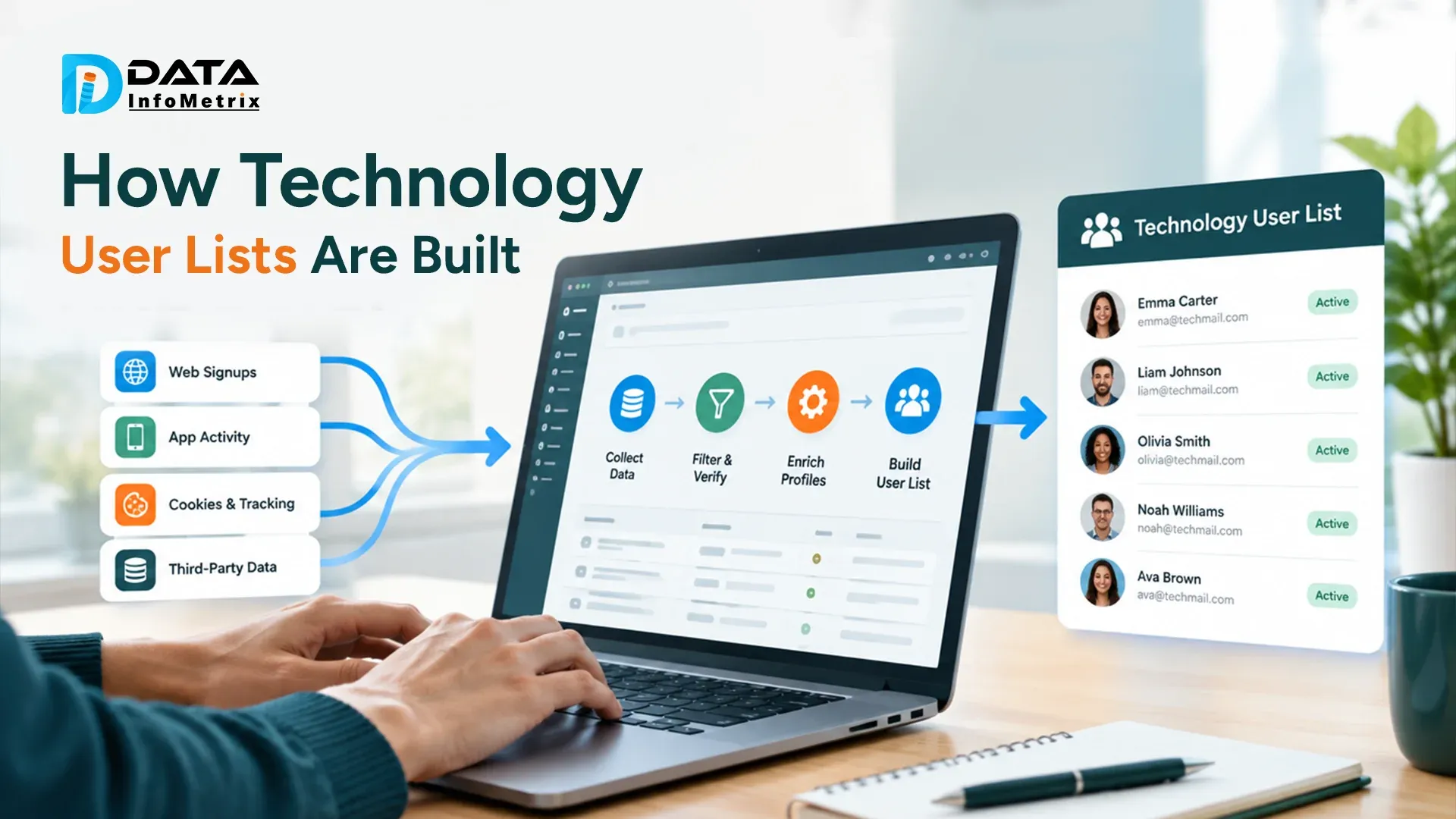
How Data InfoMetrix Builds and Delivers a Technology Users Email List
Learn how Data InfoMetrix builds technology users email lists using technographics, business signals, verification, and market intelligence.
Olivia Thomas · 4 min read
Why We Built MedicalProspects: The Problem With Generic Healthcare Data
When ZoomInfo, Apollo, and Lusha Can't Get You to the Right Room, You Need a Specialist For over ten years, DataInfoMetrix has helped B2B teams build pipeline.…
 John Britton · 4 min read
What is B2B Marketing? A Complete Guide in 2025
Introduction to B2B Marketing Evolution The B2B buying process now typically begins with a referral or an online search, with over 84% of decision-makers…
John Britton · 11 min read