
By Olivia Thomas, Director of Growth Marketing & Sales at Data InfoMetrix
TL;DR
- Most B2B teams still build target lists by asking one question: does this account fit our ICP? That question misses something important.
- What a company already runs, its CRM, its cloud stack, the competitor it uses instead of you, tells you far more about why now than industry or revenue ever will.
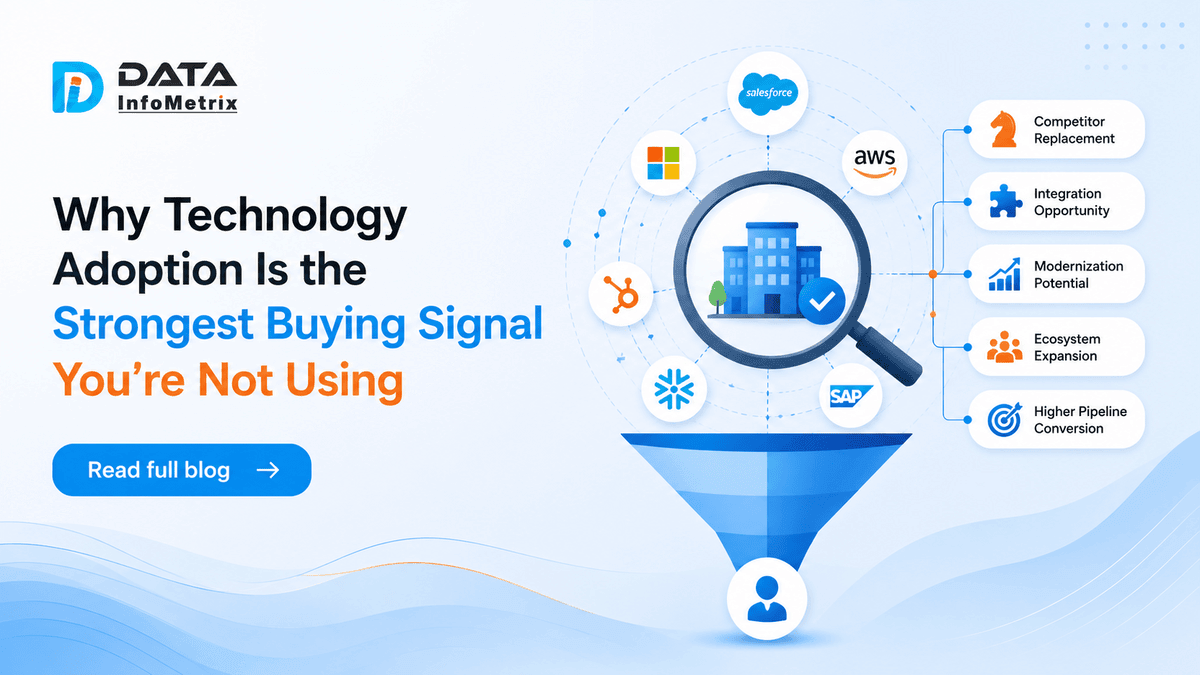
- Technology adoption isn't one signal. Depending on the relationship between the technology and your product, it points to five different plays: conquest, integration, migration, expansion, or ecosystem partnership.
- According to 6sense's 2024 Buyer Experience Report, 81% of buyers already have a preferred vendor by the time they contact a seller. If you're not visible in their world before that moment, you're not really in the running.
- Generic B2B databases answer "who works there." Installed Base Intelligence answers "what's already running there," which is the question that actually changes how you prioritize and message an account.
- A simple four-stage framework works: Identify the technologies that matter to you, Qualify against your ICP, Prioritize with intent, Activate with a campaign built around the specific technology relationship.
The List Looked Perfect. The Deal Never Should Have Happened.
Early in my career, I ran a campaign against a list that checked every box. Right industry. Right revenue band. Right headcount. Our SDR team worked it for six weeks and closed exactly one meeting that went anywhere.
Around the same time, a rep on our team pulled a much smaller list, maybe 400 accounts, filtered by one additional criterion: they were all running a specific legacy platform we knew created migration headaches. Same industry. Similar revenue. That list converted at nearly four times the rate.
Same ICP. Wildly different outcome.
That gap has stuck with me for over a decade now, through roles at two SaaS companies and an agency, and it's the reason I get a little restless whenever someone tells me their targeting strategy starts and ends with firmographics. Industry, revenue, employee count, geography. Those filters tell you whether a company resembles your best customers. They don't tell you whether your product is relevant to that company today. For that, you need a different question.
What is this company already running?
Firmographics Tell You Who They Are. Technology Tells You Where You Fit.
Picture two companies sitting side by side in your CRM. Both are 500-person SaaS businesses. Both do roughly $100 million in revenue. Both are headquartered in North America. On a spreadsheet, they're indistinguishable.
Now add one detail. Company A runs a CRM your product integrates natively with. Company B runs nothing comparable at all. Or maybe Company A is on a competitor you're built to replace, while Company B has no equivalent tool in its stack.
Are these still equally attractive accounts? They're not. The technology context just told you something firmographics never could: why this account, why now.
I've started saying this to newer marketers on my team so often it's become a bit of a mantra. Firmographics define the market. Technology adoption defines the opportunity. Both matter. But only one of them tells you where your product actually fits into a prospect's existing world.
Technology Data Is Not Just Another Filter
It's tempting to treat technology adoption as a checkbox. Show me companies using Salesforce. Show me companies running AWS. That's a fine starting point, but it undersells what the data can actually do for you.
What a company runs tells you about its infrastructure, its dependencies, its budget commitments, and often its pain points. Break that down and you get five distinct signal types worth building a strategy around:
- Existing infrastructure. What has the company already invested in and built around?
- Compatibility. Does your solution slot cleanly into that environment, or fight against it?
- Latent pain points. Certain platforms create predictable integration, scalability, or modernization headaches. That's an opening.
- Competitive context. If they're on a rival platform, you have a conquest play sitting right in front of you.
- Ecosystem relationships. Technology adoption often reveals a web of integrations, partners, and marketplace connections you can plug into.
So the real question isn't "does this company use technology X." It's "what does its technology environment tell us about the opportunity in front of us." That reframe is where a technographic data point turns into an actual GTM signal.
One Technology, Several Different Plays
Here's something that took me longer to internalize than I'd like to admit. There isn't one flavor of technology signal. The play you run depends entirely on the relationship between the technology a company uses and what you sell.
1. Competitive Technology
Points toward a conquest motion. A prospect running a rival CRM isn't a cold account, they're a warm one, because you already know what they're used to and what switching costs they'd weigh.
2. Complementary Technology
Opens an integration or cross-sell angle. Instead of pitching a brand-new category of software, you're explaining how your product extends something they've already committed budget to.
3. Legacy Technology
Signals a modernization opportunity. This one shows up constantly in cloud, ERP, and cybersecurity, where an aging platform quietly creates the business case for you.
4. Adjacent Technology
Hints at expansion potential. The company may not be actively shopping, but the environment and infrastructure exist for your solution to make sense down the road.
5. Ecosystem Adoption
Opens the door to partnership, co-selling, and marketplace plays that extend well past a single deal.
Five different technologies, five different conversations. Treating them all the same way in a single blast campaign is, in my experience, the fastest way to waste a good list.
Where Technology Adoption Fits Next to Intent Data
I get asked fairly often whether technology adoption data replaces intent data. It doesn't, and I'd argue framing it as a competition misses the point entirely. They answer different questions.
Intent data tells you about behavior: what a company is researching right now. Technology adoption tells you about context: what environment that company already operates in. One is a snapshot of current activity. The other is a foundation you build on.
According to a recent study by 6sense, in its 2024 Buyer Experience Report, 81% of buyers already have a preferred vendor by the time they make first contact with a seller, and 85% have largely settled their purchase requirements before that conversation even starts.
That number reframes a lot of what I used to believe about outbound. If a buyer has already picked a favorite before your rep gets on the phone, the work that actually matters happened earlier, quietly, in the research phase you never saw. Technology context is one of the few things that helps you show up relevant during that invisible window, because it tells you something true about the account before a single form fill or intent spike ever registers.
Layer technology fit, ICP fit, and intent together and you get something far more useful than any one signal alone. I think of it as a simple equation: Technology Fit + ICP Fit + Intent = Priority Account. None of the three inputs does the job by itself. Together, they tell you not just who's in-market, but who's in-market and sitting in an environment where your product actually makes sense.
Why Generic Databases Keep Missing the Point
Most traditional B2B databases are built to answer one question well: who works there. Name, title, email, phone number, maybe an industry code. Useful, but incomplete.
The question modern revenue teams actually need answered is different. What's already running there? That's not a contact-enrichment problem. It's an intelligence problem, and it's one that generic databases were never built to solve because they weren't designed around any single company's ICP in the first place. They were built once, for everyone, which is exactly why they go stale and why they treat every account the same regardless of what a buyer's stack actually looks like.
Take a team targeting 20,000 accounts. Without technology context, they'll segment by the usual firmographic buckets and hope for the best. With it, that same list can be split into companies running a specific competitor, companies operating a compatible platform, companies still on a legacy system, and companies sitting inside a relevant ecosystem. That's not a bigger list. It's a smarter one, built around a business problem instead of a static dataset.
This is exactly why we built Installed Base Intelligence around a different starting point at Data InfoMetrix. We don't hand clients a pre-built database and ask them to filter it down. We start with the technology that matters to their business, then research who's using it, then apply their ICP on top. Every project starts with the customer's actual profile, not a shelf product someone else already built for a different company entirely.
Turning the Idea Into a Repeatable Process
A concept is only useful if your team can actually run it every quarter without reinventing the wheel each time. Here's the process I've used across a few different go-to-market motions.
Step 1: Identify the Technologies That Matter
Not every technology a company might use, just the ones with commercial meaning for you. Which platforms do your best customers already run? Which technologies compete with you? Which ones create a migration story?
Step 2: Define the Relationship, Not Just the Fact
"Company X uses Technology Y" isn't enough on its own. Why does Y matter to you specifically? Is it a competitor, a prerequisite, a legacy platform ripe for replacement? This is the step teams skip most often, and it's the one that turns a data point into actual strategy.
Step 3: Apply Your ICP Filters
Technology relevance sharpens your targeting, it doesn't replace it. Once you know who's running the technology that matters, layer in industry, revenue, company size, and geography the way you always have.
Step 4: Layer in Intent Data
Which of those technology-relevant accounts are actively researching your category right now? That's where the priority list gets short and sharp.
Step 5: Build Campaigns Around the Relationship
Don't send the same message to a competitor's customer and a complementary-technology prospect. The technology signal should shape the message, not just the target list.
| Technology Signal | Likely GTM Play |
|---|---|
| Competitor user | Conquest campaign |
| Legacy platform | Migration campaign |
| Complementary technology | Integration campaign |
| Existing ecosystem | Expansion or add-on campaign |
| Relevant technology + active intent | High-priority ABM |
| Ecosystem partner | Co-selling or partnership motion |
If you want the shorthand version, it's four words: Identify, Qualify, Prioritize, Activate. Technology adoption feeds ICP fit, ICP fit feeds intent, and intent feeds the campaign you actually build. Skip a step and the whole thing collapses back into a static field nobody looks at after the first quarter.
Does This Actually Move the Needle, or Is It Just a Nicer Filter?
Fair question, and one I ask my own team before we greenlight any technology-led campaign. The honest answer is that it depends entirely on whether you follow through to activation. A technology filter that just narrows a list without changing the message underneath it isn't doing much.
According to a recent study by Forrester, in its 2024 account-based marketing ROI data, ABM programs most commonly deliver 21% to 50% higher ROI than non-ABM efforts, with 23% of respondents reporting ROI gains of 51% to 200% higher, consistent across North America, Europe, and Asia Pacific.
That consistency across regions is what stands out to me. ABM works when the account selection is actually tight, and technology adoption is one of the tightest filters I know for building an account list where every name has a specific, explainable reason for being on it. A generic ICP list gives your reps a name and a title. A technology-qualified list gives them an opening line.
There's also good evidence that pairing technology context with predictive and intent data compounds the effect rather than just adding to it. 6sense reports that among its own customers, accounts identified as qualified through intent and predictive signals showed an average opportunity value 99% higher than accounts that weren't flagged that way. I've seen a similar pattern play out on a smaller scale in my own campaigns: once you stack a relevant technology signal on top of ICP and intent, deal sizes tend to skew larger, not just more frequent. It makes sense when you think about it. An account with a real technology-driven reason to buy usually has a real budget-driven reason too.
Where Should Your Attention Actually Go?
If you're building a technology-led motion for the first time, don't try to boil the ocean. Start with five categories and watch which one produces the best-fit conversations for your team.
Competitive adoption tells you who's running your rivals, useful for conquest and replacement plays. Integration adoption tells you who's already running platforms you connect with, useful for demand generation built around a real technical fit. Legacy adoption points you toward modernization and migration conversations. Ecosystem adoption opens partner and marketplace motions. Expansion adoption flags accounts with the infrastructure for an adjacent product, even if they're not shopping yet.
Which of those five feels most urgent for your pipeline right now? For most of the SaaS teams I've worked with, competitive and integration adoption produce the fastest wins, while legacy and ecosystem plays take longer to mature but tend to build bigger, stickier accounts once they close.
The Shift From ICP-Only to ICP-Plus-Technology
I'm not suggesting anyone throw out their ICP work. That would be a mistake. What I am suggesting is adding a layer most teams skip entirely.
Traditional targeting moves in a fairly predictable line: ICP, then industry, then company size, then revenue, then geography, then job function, then prospecting. It produces a broad, reasonably accurate market.
Technology-first targeting adds a layer in the middle: ICP, then target technology, then the relationship that technology has to your product (competitor, complement, legacy, adjacent), then your standard company and contact filters, then intent signals, then a prioritized account list, then the campaign. It's a longer path, but it produces a market that actually explains itself. Every account on the list comes with a built-in answer to the question every good rep should be asking before they pick up the phone: why should I care about this account specifically?
Where I Land on All of This
The strongest prospect in your CRM isn't always the one with the biggest revenue number or the loudest intent score. Sometimes it's just the account that's already telling you, through its own tech stack, why your product belongs in the conversation.
That signal might mean they're a competitor's customer ready for a conquest play. It might mean they're sitting inside an ecosystem you already serve. It might point to an integration opportunity, a migration need, or simply a technology environment where your solution is a natural next step. None of that shows up on a standard firmographic filter.
This is the whole reason Installed Base Intelligence exists as a category, and why I think it deserves a bigger seat at the GTM table than it currently gets. At Data InfoMetrix, we don't start with a static database and hope it fits your business. We start with the technology you actually want to target, then build the audience around your ICP, then layer in the intent and context that make it actionable, all sourced fresh with our full triple-verification process rather than pulled off a shelf. With over 70M+ installed base contacts researched to order, the goal isn't the biggest list. It's the most precise one for your specific technology relationship.
So don't just ask whether an account fits your ICP. Ask what it's already running. Ask what that technology relationship actually means for your product. Then ask what opportunity it creates. The better signal is usually already sitting inside a prospect's own stack. You just have to know where to look.
FAQs
What is Installed Base Data, and how is it different from a regular B2B contact list?
Installed Base Data identifies companies actively using a specific technology, platform, CRM, ERP, cloud infrastructure, or industry-specific system. A regular B2B list tells you who works at a company. Installed Base Data tells you what that company already runs, which is what makes it possible to build a campaign around a specific, provable reason an account is relevant to you.
Isn't technographic data just another filter layered onto firmographics?
It can be used that way, and if it is, you won't see much lift. The value shows up when you define the relationship between the technology and your product (competitor, complement, legacy, adjacent, ecosystem) and let that relationship shape the campaign itself, not just the target list.
How does technology adoption data work alongside intent data?
They answer different questions and work best together. Technology adoption tells you about a company's existing environment. Intent data tells you about current research behavior. Combined with ICP fit, the three create a much stronger basis for account prioritization than any single signal on its own.
What use cases benefit most from Installed Base Intelligence?
The categories I see the most traction with are competitor conquesting, technology migration campaigns, integration ecosystem targeting, add-on and marketplace expansion, implementation and advisory partner targeting, market research recruitment, event attendee acquisition, and custom technology audience sourcing.
Is Installed Base Data a downloadable, off-the-shelf list?
No, and that's intentional. At Data InfoMetrix, every project starts with the client's ICP and the specific technology they want to target, and the data is researched fresh for that engagement rather than pulled from a static, pre-built database.
How do you keep the data accurate?
Every contact list goes through triple verification: SMTP validation, bounce reduction, and spam trap removal, so you're working with fresh, deliverable data rather than a stale export.