





Why SAP Adoption Alone Doesn't Tell You What a Manufacturer Needs
SAP adoption reveals a manufacturer's technology environment, not its next need. Learn which business and buying signals provide the missing context.

By Olivia Thomas, Director of Growth Marketing & Sales at Data InfoMetrix
For SaaS providers, integration consultancies, and enterprise software vendors, discovering an account that uses SAP is striking gold. It signals an established enterprise environment with complex operations, supply chains, financial processes, and significant technology investment.
The immediate reaction from a sales lead, RevOps director, or product marketer is often:
“If they use SAP, they probably need what we sell.”
That is where things get interesting.
Teams frequently identify SAP users and immediately build a solution hypothesis around the technology. The problem is simple: SAP adoption tells you what a manufacturer has. It does not automatically tell you what the manufacturer needs next.
One SAP user may be expanding production, another may be dealing with supply-chain disruption, and a third may be migrating systems or focusing on workforce challenges.
All of them can appear in the same SAP users database, yet only one may be ready for the conversation you want to have. That distinction matters to position your competitive software, integration services, and complementary solutions.
What SAP Adoption Actually Tells You About a Manufacturer
SAP adoption is valuable account intelligence. Knowing a manufacturer uses SAP can reveal important context about its business and technology environment, which is crucial for prioritizing the right accounts to start your sales conversation.
Here’s what it tells you about a manufacturer:
- Which SAP products does he/she use
- The maturity of his/her enterprise systems
- The scale of his/her operations
- Existing technology investments
- Parts of the broader technology environment
For example, knowing that a company is pursuing or has completed an SAP S/4HANA implementation is more useful than simply labeling it an SAP customer. However, there is a limit to what this information can tell you.
SAP adoption answers: What technology is already part of this company's environment?
It does not answer: What business problem is this company trying to solve now?
That difference becomes clearer when you examine where organizations are in their SAP journeys. SAPinsider's 2025 benchmark found that 32% of surveyed companies had already transitioned to SAP S/4HANA, while 27% were actively implementing it and another 21% were still evaluating their business case.
A completed migration, an active implementation, and an evaluation represent very different buying contexts. Treating them as identical would be like seeing three people near an airport and assuming they are all taking the same trip.
Why Two SAP-Using Manufacturers Can Have Completely Different Needs
Consider two manufacturers.
Manufacturer A
It uses SAP, and its production network is stable. No new facilities are planned, there is no major modernization initiative underway, and leadership has remained largely unchanged.
Manufacturer B
It also uses SAP, but it is opening a new production facility, expanding into a new region, redesigning parts of its supply chain, and hiring transformation specialists.
On paper, both are simply manufacturers using SAP. In reality, they are very different accounts.
Manufacturer A may become an excellent customer in the future, but Manufacturer B gives a seller a much stronger reason to investigate today.
The shared technology matters, yet the changes happening around that technology often matter more for locating active buyers, timing sales outreach, and creating immediate deal relevance.
A more useful question is not: “Do they use SAP?”
It is: “What is happening inside this manufacturer that could make our solution relevant?”
That question is harder to answer, but it is also far more valuable to identify the right opportunities in the SAP market.
The Manufacturing Changes SAP Adoption Alone Doesn't Show You
SAP data largely reflects what already exists, while the strongest clues about future needs often come from what is changing.
Business Expansion
A new plant, geographic expansion, acquisition, or increase in production capacity can quickly reshape a manufacturer's priorities. Expansion can create new requirements across the supply chain, logistics, integration, workforce, infrastructure, and financial operations.
The goal is not to assume what a company will buy. The value lies in understanding which new challenges expansion may create and why they matter.
For instance, a manufacturer growing through acquisition may need to integrate financial systems, applications, processes, and teams. Its SAP finance environment explains the technology foundation, while the acquisition explains why change may suddenly matter.
You need both pieces of information to increase the possibilities of attracting an enterprise deal through ABM.
Operational Transformation
Manufacturers are investing across a wide range of operational priorities.
A 2025 Deloitte survey of 600 manufacturing executives found that 46% view process automation as their top-two investment priorities for the next two years.
Other priorities included data analytics at 40%, advanced production scheduling at 35%, execution systems at 33%, and cloud computing and AI at 29% each.
The takeaway is simple: There is no single "manufacturer need."
One SAP user may prioritize scheduling, while another may focus on analytics, automation, or quality management. Knowing they all use SAP does not tell you which conversation belongs at the top of your outreach strategy.
Technology Transformation
SAP is rarely the only technology in a manufacturing environment. Manufacturers increasingly combine enterprise platforms with cloud infrastructure, data analytics, Industrial IoT, AI, and other connected technologies.
As a result, SAP is only one piece of a larger technology picture. A company using SAP may also be modernizing data infrastructure, experimenting with AI, connecting industrial assets, or upgrading surrounding applications.
Even a legacy technology footprint, such as SAP Sybase ASE, can provide useful context. However, technology alone does not tell you whether modernization is happening today.
The change is the clue. To pinpoint ready-to-migrate SAP accounts, you need additional intelligence. This includes hiring signals, fundraising, Mergers & Acquisitions, and regulatory or EOL (End-Of-Life) pressure.
Workforce and Leadership Changes
People's changes can also reveal where attention is shifting. A new CIO may signal a change in technology leadership, while a new head of supply chain may bring a different operational agenda.
Hiring enterprise architects or transformation specialists can indicate that a company is building capabilities in a specific area. A growing workforce or changes in the SAP SuccessFactors environment may also provide useful context.
However, an important caution applies:
Important Caution: A new executive does not equal buying intent. Hiring does not equal buying intent either. These are investigative signals that tell you where to look next, not what will definitely happen.
Confusing interesting news with a qualified opportunity is a common GTM mistake.
SAP Adoption Means Something Different Depending on What You Sell
There is no universal SAP buying signal because relevance depends on the problem you solve.
| Solution Category | SAP Adoption Alone Suggests | Changes Worth Investigating |
|---|---|---|
| Supply-chain solutions | Enterprise operational environment | Inventory, planning, logistics, supply-chain transformation |
| Industrial automation | Established manufacturing systems | New plants, capacity growth, automation initiatives |
| Workforce solutions | Enterprise workforce infrastructure | Hiring, expansion, workforce transformation |
| Financial solutions | Established financial processes | Acquisitions, restructuring, geographic growth |
| Data and analytics | Significant enterprise data environment | Analytics modernization, AI initiatives |
| Customer solutions | Structured customer operations | CRM modernization, customer transformation |
| Commerce solutions | Digital business infrastructure | New digital channels, commerce expansion |
| Infrastructure services | Complex enterprise environment | Migration, integration, modernization |
A manufacturer using SAP CRM may be relevant to companies selling customer data, analytics, or engagement solutions. However, SAP CRM adoption alone does not prove that user transformation is a current priority.
The same applies to SAP Commerce Cloud. It may indicate that digital commerce exists within the environment, but not whether the company is expanding, redesigning, or replacing anything.
The technology provides context. The change provides relevance.
Why "Why Now?" Matters More Than "Who Uses SAP?"
Most account lists answer the "who" question. Who uses SAP? Who operates in manufacturing? Who matches a certain company size?
Those questions are useful because they help define the market. Eventually, GTM teams face a more important question: Why now?
A manufacturer that has used SAP for ten years may still be relevant to you, but why should your SDR contact that company this quarter?
The answer rarely comes from SAP adoption alone. More often, it comes from multiple changes appearing together.
For example:
- SAP customer + plant expansion is more informative than simply the SAP account.
- SAP customer + plant expansion + supply-chain hiring + automation initiative provides an even stronger reason to investigate.
Those combinations provide an even stronger reason to investigate.
Manufacturers are not moving through transformation at the same pace. Some are researching new technologies, others are piloting them, and some are already scaling them across operations.
Rockwell Automation's 2025 State of Smart Manufacturing Report found that 56% of surveyed manufacturers were piloting smart manufacturing, while 20% were using it at scale and another 20% were planning investments.
The overall trend may be similar, but the stage is not. A company researching, piloting, and scaling a solution has very different needs at each phase.
That is why signal clusters are valuable. They help GTM teams move beyond static labels and better understand the timing and direction of change.
They do not guarantee a purchase. They simply provide a stronger reason to ask the next question.
How GTM Teams Can Avoid Misreading SAP Customer Data
The first step is to stop asking SAP data to answer questions it cannot answer.
Don't Start With the Solution
Avoid this: “They deploy SAP, so they probably need our product.”
Start with: “They use SAP. What else is happening inside the business?”
Look for Meaningful Changes
Investigate key business triggers:
- Expansion
- Acquisitions
- New facilities
- Technology initiatives
- Leadership changes
- Operational transformation
- Relevant hiring
Connect the Change to Your Solution
Not every change is relevant to every seller. A warehouse expansion may matter greatly to a logistics provider and very little to a cybersecurity company.
Context bridges the gap between a raw signal and your specific solution. It provides the relevant, undeniable reason behind your outreach and grounds your first sales pitch in real customer reality.
Identify the People Closest to the Change
The person responsible for an initiative is not always the CIO. Depending on the project, the relevant stakeholder may sit in operations, supply chain, finance, HR, engineering, or digital transformation.
An enterprise account is not a single buyer. Many still think as if it is. According to Gartner’s research on the B2B buying journey, a typical B2B (Business-to-Business) purchase involves 6 to 10 decision-makers, each with their own opinions, research, priorities, and queries.
Tracking SAP accounts isn't about collecting static company data. It is about capturing the specific signals and behaviors across these different departments to understand what is changing, who is driving it, and why now.
Spotting These Signals Manually Can Take Ages
Data InfoMetrix combines SAP intelligence, decision-maker data, and intent signals to help you identify accounts worth investigating faster.
Find the Signals Behind the Account!SAP Adoption Is the Starting Point, Not the Answer
SAP adoption matters because it helps identify manufacturers that belong in your potential account universe and provides valuable technology context.
However, it cannot tell you what a manufacturer needs next. It cannot reveal whether a company is expanding, modernizing, automating, migrating, restructuring, or standing still.
For revenue teams, the better question is no longer: “Which manufacturers use SAP?”
It is: “What is changing inside SAP-using manufacturers that matters to us?”
SAP adoption tells you where to look. The business, operational, technology, and buying signals around that adoption help reveal what may be worth finding, so you can align your solutions directly to their current challenges.
Frequently Asked Questions
Is SAP adoption a buying signal?
SAP adoption is a useful account and technographic signal, but it is not buying intent by itself. It shows that a company has invested in SAP, while business changes, technology initiatives, leadership activity, and other signals provide additional context about future needs.
What does SAP technographic data tell sales teams?
SAP technographic data helps identify companies using specific SAP products and understand parts of their technology environment. Sales teams should combine it with company, contact, business-change, and intent data intelligence to build a more complete account view.
Why can two manufacturers using SAP have different buying priorities?
Manufacturers differ in size, operations, growth plans, technology maturity, and transformation priorities. One may focus on automation while another prioritizes supply-chain modernization or workforce transformation. Their shared SAP environment does not make their current needs identical.
What should GTM teams look for beyond SAP adoption?
Look for changes such as plant expansion, acquisitions, technology modernization, relevant hiring, leadership changes, operational transformation, and other signals connected to the problem your solution solves.
 Written byOlivia ThomasDirector of Growth Marketing & Sales
Related articles
Salesforce Is Buying Braze. What Happens to 2,770 Customers in the Meantime?
Salesforce announced an agreement to acquire Braze for $5.66B. Explore what happens to 2,770 Braze customers, why ownership changes reopen tech renewals, and how GTM teams can navigate the window.
Olivia Thomas · 6 min read
Inside the 2026 Executive Research Series: Announcing 4 Comprehensive eBooks and 4 Empirical Whitepapers on B2B Installed Base Intelligence
Data InfoMetrix releases its landmark 2026 Executive Research Series: 4 tactical eBooks and 4 empirical Whitepapers providing research-backed benchmarks on technographic data decay, legacy migration cycles, and account selection.
Olivia Thomas · 9 min read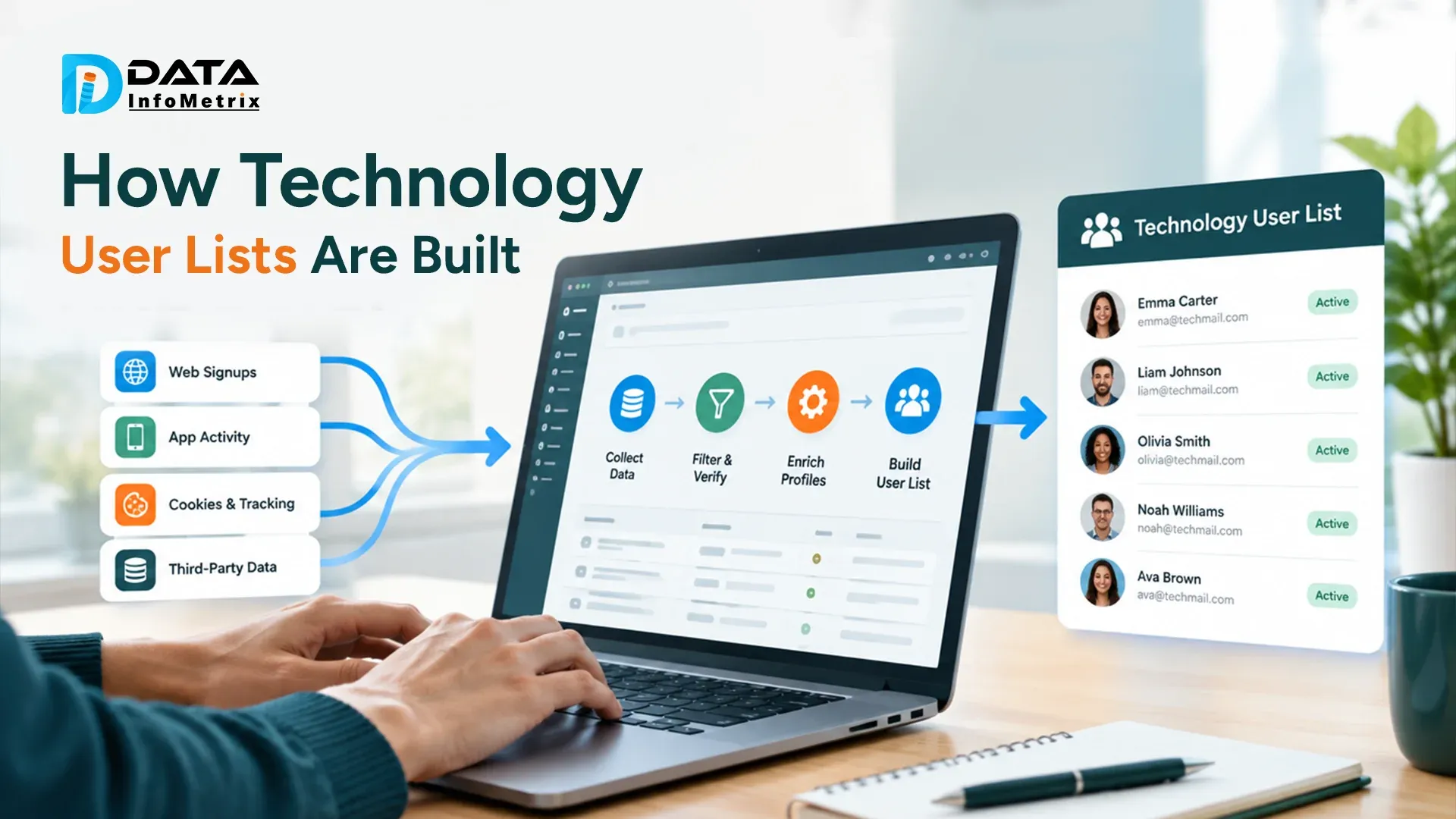
How Data InfoMetrix Builds and Delivers a Technology Users Email List
Learn how Data InfoMetrix builds technology users email lists using technographics, business signals, verification, and market intelligence.
Olivia Thomas · 4 min read