




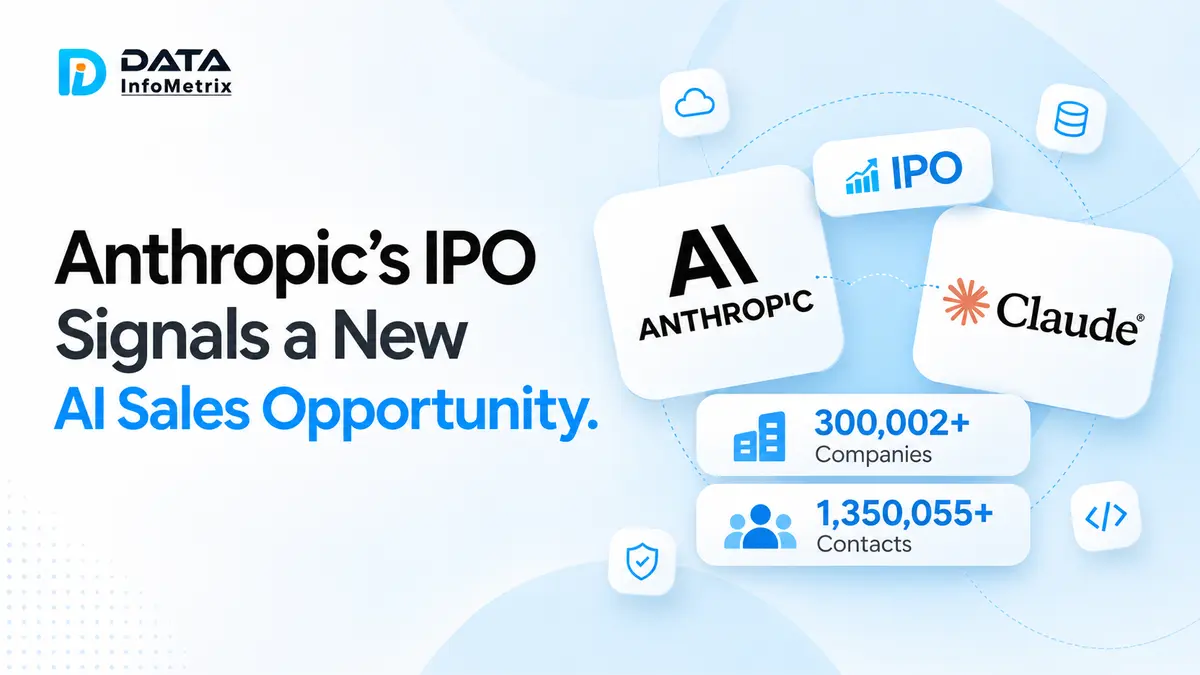
Anthropic's IPO Filing Shows Who Is Buying AI. Here Is Who Should Be Calling Them.
Anthropic's S-1 puts hard numbers on enterprise AI adoption. For the vendors, integrators, and consultants built around that adoption, the real question is which accounts to reach first, and how to find them before a competitor does.
By Olivia Thomas, Director of Growth Marketing & Sales at Data InfoMetrix
I opened Anthropic's S-1 the morning it was filed, coffee going cold, expecting a story about valuation. What held my attention was a paragraph about partners.
According to Anthropic's Form S-1, filed with the U.S. Securities and Exchange Commission on October 26, 2026, Claude is available on AWS, Google Cloud, and Azure, and customers can also reach it through systems integrators such as Accenture, Deloitte, KPMG, and PwC, and through data platforms such as Salesforce and Snowflake. The company lists ecosystem partnerships as part of its growth strategy.
I have spent twenty years in B2B marketing and sales, and when a company of this size tells the market it will grow through other firms' customer relationships, I pay attention. It means the money is moving through channels. And wherever money moves through channels, a lot of vendors are about to go looking for the same accounts at the same time.
So this is not really an article about Anthropic. It is about the people who sell to the organizations adopting AI, and about a problem most of them have not solved yet.
What the filing actually says
The numbers first, because they are worth reading slowly.
As of September 30, 2026, Anthropic reports more than 11,900 customers with at least $100,000 in trailing twelve-month revenue, more than 1,900 above $1 million, and approximately 250 above $10 million. It uses the $100,000 line as its own yardstick for enterprise adoption, and it says plainly that it does not track an “enterprise” segment as a separate category. Revenue for the first half of 2026 came in at $16.286 billion, against $1.163 billion for the same period in 2025. That is roughly fourteen times higher.
Two cautions. These are revenue thresholds, not a headcount of every organization that touches Claude. And the filing is full of risk language, from compute dependence to competition, which is what a preliminary prospectus is supposed to contain.
Still, I keep coming back to the pattern underneath the figures. When I led partner programs earlier in my career, the vendors who profited most from a platform's growth were rarely the platform's closest competitors. They were the implementers, the integrators, the add-on builders, the security and data companies who showed up in the right accounts early. Revenue at the center creates demand at the edges.
Which raises the question that matters for a sales leader. If you sold to the edges, how would you know which accounts to call?
Adoption is wide. Readiness is not.
Here is the data point I would tape to every GTM planning deck this quarter.
According to a recent study by McKinsey & Company, in its The State of AI in 2025 survey, 88 percent of respondents reported that their organizations use AI in at least one business function, up from 78 percent a year earlier. Only 7 percent said AI had been fully scaled across their organizations. The survey covered 1,993 participants and ran from June 25 to July 29, 2025.
That gap is the whole story for anyone selling around AI. I have personally burned budget on exactly this mistake: building a campaign around “companies that use [a technology category]” and watching it produce opens, a handful of polite replies, and almost no meetings. The signal was real. It was also thin. The accounts were using the technology, but most were nowhere near the stage where our offer mattered.
McKinsey's numbers say that is not a one-off. Most companies using AI are still early. So “uses AI” is not a target. It is a starting point, and a vendor who treats it as a finish line will spend a lot of money reaching people who are not ready to buy.
Who benefits when enterprises adopt AI
The ecosystem around any large platform shift tends to sort itself into a few groups, and AI looks no different.
Cloud and migration partners come first, because AI workloads change how organizations think about capacity, architecture, and cost. Security and governance vendors follow, since every new system that touches company data raises questions about access, identity, and controls. Then you have the integrators and implementation firms, who are quietly the busiest people in any adoption cycle because nothing works in isolation. The data and analytics companies come next. AI is hungry for clean, connected data, and most organizations discover how messy theirs is only after the pilot starts. And finally the software vendors whose products work better next to an AI platform than away from it, in developer tools, testing, workflow automation, and observability.
Anthropic itself points at this structure. The filing describes an AI services company it launched with private equity firms, named Ode with Anthropic, aimed at mid-sized companies. The company is building a channel because it knows the market will not be served by a single vendor.
One qualification, and I mean it. AI adoption does not equal buying intent. A company using Claude is not a company that wants your product. It is a company whose technology environment might make your product relevant, which is a very different thing, and the difference is where good targeting lives.
Why generic B2B databases fail this test
Most B2B databases answer a familiar set of questions. What industry? How many employees? What revenue band? Which region? Who sits in the executive team?
Those answers are useful for sizing a market. They tell you very little about what a company runs.
Picture a cybersecurity vendor that wants to reach enterprise software companies with more than 1,000 employees. A conventional database returns thousands of matches. Some of those companies run a cloud platform your product integrates with. Others run something else entirely. A few have adopted the AI tools that make your governance story relevant, and most show no sign of it. Every one of them fits the firmographic profile. Only a fraction fit the sales motion.
The cost shows up later, and it is rarely traced back to the list. Reps spend discovery calls learning that the prospect's stack does not match. Marketing sends a technology-specific message to accounts that never use the technology. Conversion looks weak, so someone rewrites the subject line.
This is the problem Installed Base Data exists to solve. Firmographics tell you which companies resemble your customers. Installed Base Data tells you which of them use the technology that makes your offer relevant. Those are different questions, and the second one is far closer to a purchase decision.
It will not remove the need for qualification. Technology coverage varies, and a technology association is evidence, not proof of active use. But starting a campaign from a relevant technology environment beats starting from an employee-count filter, and in my experience the difference shows up in meeting quality before it shows up in anything else.
Four ways I would put this to work
Competitor conquesting. If you sell an alternative to an established product, that product's installed base is your most relevant starting market. Research the organizations using it, qualify them by size, industry, geography, and need, and build messaging that speaks to what makes your approach different. Do not assume they are unhappy. Some are, many are not, and your job is to find the ones for whom your story lands.
Integration ecosystem targeting. A CRM consultancy wants companies on the CRM platforms it implements. An integration provider wants organizations running the applications it connects. The technology tells you the account is plausible, and then you do the human work of finding the right person. Sales leaders tell me the first ten minutes of an outbound call feel completely different when the rep already knows the environment.
Add-on and marketplace expansion. Vendors that sell apps, extensions, or complementary tools often know exactly which platform environments suit them best. An installed base audience built around those platforms puts the offer in front of people who can use it on day one.
Implementation and advisory firms. Migration partners, ERP and cloud specialists, and AI advisory teams live or die by relevance. They win when the account runs the systems they know. An audience researched around those systems keeps pipeline conversations on territory where the firm is credible.
Technology data will not guarantee higher conversion or faster pipeline by itself. Offer relevance, timing, and sales execution still decide outcomes. What it does is give those other pieces a better audience to work on.
A working process, in the order I would run it
Start with the commercial objective, and be specific about it. “Win accounts from a competitor in mid-market healthcare” is an objective. “Grow pipeline” is a wish.
Then write the ICP in terms of buying relevance, which means industry, size, geography, and business model, and only after that add the technologies that matter. The technology complements the ICP. It never replaces it, and I have watched teams forget that and end up with a perfectly accurate list of the wrong companies.
Third, choose the technologies with care. For a conquesting campaign, it is the competing product. For an implementation partner, it is the platform the firm specializes in. For an add-on vendor, it is whatever environment your product plugs into.
Fourth, research the installed base and the contacts together. Verify the technology evidence, then match the right roles at each account and verify the contact data, including email verification, bounce reduction, and spam-trap removal. None of this guarantees deliverability, so sending practices still matter.
Last, write the message around the problem you solve, and measure what the campaign produces. Qualified meetings, opportunities created, pipeline contribution, cost per opportunity. Where you can, hold out a control group so you learn whether technology targeting added value or merely changed who you reached.
How many of your current campaigns could survive that last test?
Why custom and fresh matters more than size
Technology adoption moves. Companies migrate, consolidate, switch vendors, and expand deployments. An account associated with a technology two years ago may have moved on, while a brand new adopter may not appear in an older file at all.
That is why we do not hand clients a downloadable list at Data InfoMetrix. Every project begins with the client's ICP and the technology question they need answered, and the data is sourced on demand around it. Our work covers 70M+ Installed Base Contacts, and the point is not the size of that number. It is that the research starts with your target technology instead of hoping your target is already in a database built for something else. Contacts go through SMTP verification, bounce reduction, and spam-trap removal before they reach you.
I get asked whether that approach is slower than buying a file. It is, slightly. It is also the reason the campaigns that come out of it tend to survive first contact with a sales team.
What I would do this week
The AI boom gives every technology vendor a reason to rethink targeting right now. Anthropic's filing is one data point, and a loud one, but the same logic applies to any platform your product depends on or competes with.
Pick one technology that defines your best customers. Write down what you know about the environments where your product works and where it does not. Then ask whether the list you are about to buy or build reflects that knowledge, or whether it only reflects company size and industry.
If your next campaign depends on reaching organizations that already use a specific technology, start with the installed base. Tell us which technology you want to target and describe your ICP, and our team can scope the research for a custom company and contact audience.
If you are planning targeted outreach across the modern AI ecosystem, explore our verified AI Infrastructure installed base lists—including enterprise audiences for Anthropic Claude users, AWS Bedrock users, and OpenAI users—or scope your target audience with our interactive Tech Audience Builder.
If you want to talk through scoping a custom technology-specific audience built around your ICP, get in touch with the Data InfoMetrix team and we will walk you through how we build it.
Explore Installed Base Data at Data InfoMetrix.
Editorial note: Anthropic's customer figures, revenue, and IPO status reflect its publicly filed Form S-1 as of October 27, 2026. The registration statement is preliminary and the offering terms are not yet set. This article discusses go-to-market opportunities created by technology adoption. It does not claim that Data InfoMetrix holds a verified list of Claude users.
 Written byOlivia ThomasDirector of Growth Marketing & Sales
Related articles
Salesforce Is Buying Braze. What Happens to 2,770 Customers in the Meantime?
Salesforce announced an agreement to acquire Braze for $5.66B. Explore what happens to 2,770 Braze customers, why ownership changes reopen tech renewals, and how GTM teams can navigate the window.
Olivia Thomas · 6 min read
Inside the 2026 Executive Research Series: Announcing 4 Comprehensive eBooks and 4 Empirical Whitepapers on B2B Installed Base Intelligence
Data InfoMetrix releases its landmark 2026 Executive Research Series: 4 tactical eBooks and 4 empirical Whitepapers providing research-backed benchmarks on technographic data decay, legacy migration cycles, and account selection.
Olivia Thomas · 9 min read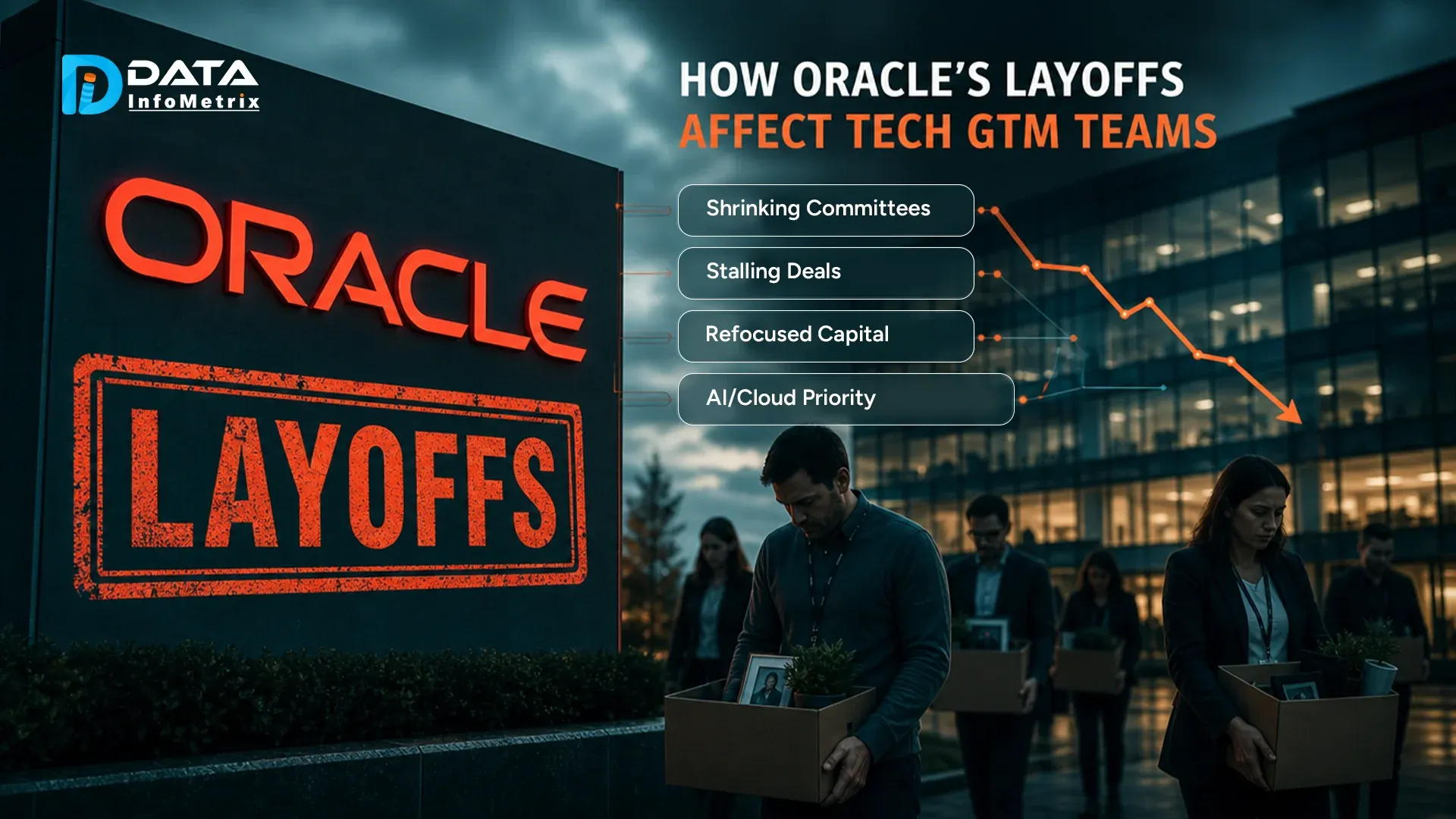
What Oracle’s 2026 Layoffs Mean for GTM Teams
Explore how Oracle’s 2026 layoffs reshape buying teams, capital priorities, sales cycles, and vendor strategies for technology companies selling to Oracle.
Olivia Thomas · 6 min read