





Five Shifts That Turn ERP Installed Base Into Revenue Opportunities
B2B marketers, RevOps teams, and growth managers selling into ERP accounts: your installed base hides pipeline. Here are 5 shifts to spot it.
By Olivia Thomas, Director of Growth Marketing & Sales at Data InfoMetrix
For decades, ERP sales followed a simple cycle: companies bought a system, implemented it, used it for years, and replaced it when it became outdated.
That cycle has changed. Cloud ERP, AI, integrations, data upgrades, and regular updates mean companies are improving their ERP systems more often. ERP is no longer a one-time purchase. It is an ongoing technology investment.
According to Companies History.com, cloud ERP adoption reached 64% in 2024, up from just 20% in 2020. That kind of movement doesn't happen in a market where companies buy once and sit still. It happens because ERP customers are constantly re-evaluating, upgrading, and extending their core accounting infrastructure, and the same shift is visible across major ERP ecosystems.
For businesses selling ERP-adjacent solutions, this change makes your existing ERP installed base one of the most important sources of future opportunity. Understanding ERP adoption patterns, ERP customer data, and the technographic data behind them starts with recognizing the five specific shifts driving this change and turning existing customers into revenue opportunities.
Without further delay, let's dive in!
Five ERP Shifts That Turn Installed Base into GTM Opportunities
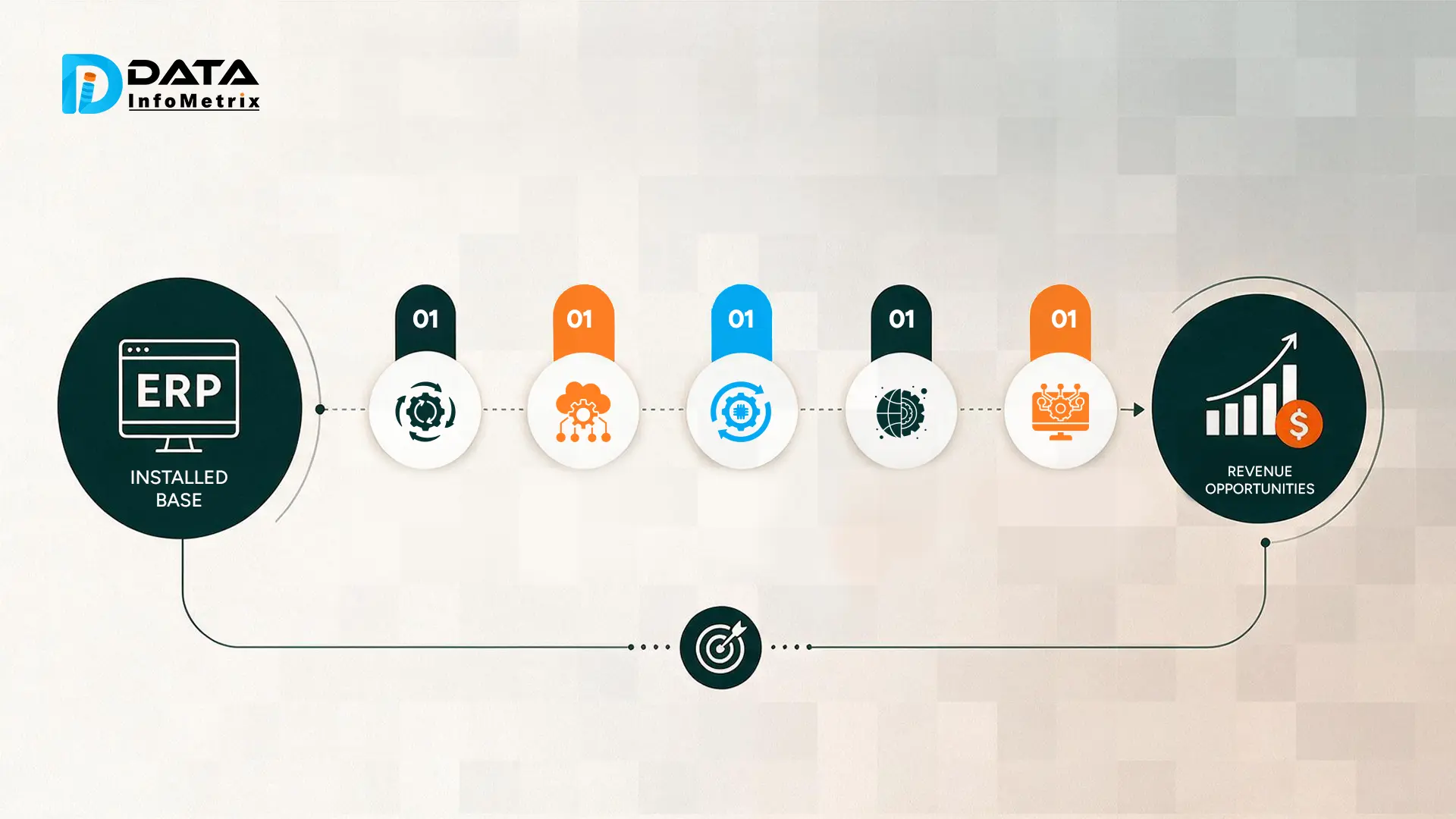
Here are five shifts in the ERP ecosystem that are quietly turning existing customers in your installed base into a goldmine for B2B go-to-market teams.
1. Legacy ERP is entering a modernization cycle
Legacy ERP modernization is the biggest opportunity in the market. A meaningful share of customers in your installed base are still running on-premise or heavily customized ERP systems that were never designed for cloud scale, AI workloads, or modern integration patterns.
As those systems age, companies are moving toward cloud and modern architectures, often years before the vendor's official end-of-life deadline forces the issue.
This creates sustained opportunity in migration, implementation, integration, consulting, infrastructure, and managed services, not a single event but a multi-year window.
Several more shifts signal even more revenue opportunities.
2. Cloud ERP is changing the customer lifecycle
Once a company moves to cloud ERP, the relationship doesn't end at go-live. Cloud ERP turns ERP from a periodic replacement decision into a continuously evolving environment, with quarterly releases, new modules, and expanding vendor ecosystems.
That opens the door to optimization, extensions, integrations, security, and adjacent applications on an ongoing basis rather than a five-year cycle.
3. AI is turning ERP from a system of record into a system of action
ERP data has always been rich, but historically passive. AI and agents are beginning to operate across enterprise workflows built on top of that data, from demand forecasting to automated approvals.
According to DocuClipper's 2025 report, 65% of ERP vendors are expected to integrate AI and machine learning capabilities into their platforms to enhance forecasting, analytics, and approval processes.
This single stat signals a wave of new buying moments, spanning AI applications, automation tooling, governance, and analytics, inside accounts that already have ERP in place and have no plans to switch platforms.
4. ERP is becoming part of a larger technology ecosystem
ERP increasingly connects with CRM, HCM, data analytics platforms, SCM, AI, security, and integration tools, often through dozens of point-to-point connections or a middleware layer.
The ERP itself may not be the next purchase. Something around it, an integration platform, a data warehouse, an analytics layer, might be, and that purchase is often driven by the same team that owns the ERP relationship.
5. Data modernization is becoming central to ERP strategy
ERP systems generate enormous volumes of operational data, but much of it stays locked inside the platform or scattered across disconnected modules.
Companies want more value from the data sitting inside and around their ERP systems, which drives demand for data integration, analytics, governance, and data quality tools, often as a direct follow-on to an ERP implementation or migration project.
Spotting these shifts is only useful if you can act on them, and that starts with the ERP users data intelligence itself.
Turning an ERP Users List Into a Revenue Roadmap
An ERP users list tells you who already has an ERP environment. That's only the beginning of the story, not the end of it.
A marketing intelligence built two years ago might still be technically accurate about which platform a company uses, while completely missing that the company has since started a migration, added an AI initiative, or brought on a new integration partner.
This is where technographic data earns its keep. LandBase's 2026 statistics reveal that organizations using technographic data achieve 28% higher conversion rates in B2B marketing and are 50% more likely to exceed their revenue goals compared to those using traditional targeting methods.
Turning that raw list into a working revenue roadmap happens in five steps:
Step 1: Map the installed base
Who uses which ERP? This is the foundation, but treat it as a starting point, not a finished asset.
Step 2: Understand the environment
What technologies sit around the ERP, from CRM to data warehouses to security tools? This tells you how complex the account's stack really is.
Step 3: Identify change
What is being upgraded, migrated, integrated, or added right now? This is where technographic and intent signals matter most, since change is what creates urgency.
Step 4: Connect change to business needs
What technology requirement could emerge from that change? A cloud migration, for instance, often creates a downstream need for integration, security review, or data cleanup.
Step 5: Identify the relevant buying group
Who owns that transformation, and who else needs to sign off on it? ERP-related purchases rarely involve a single decision maker. It involves a complete buying committee, such as CTOs, finance heads, CEOs, and legal and compliance officers.
Sales teams working from a raw list, without that added layer of technology usage data, are effectively targeting blindly, reaching out based on what a company used to run rather than what's actually happening in the account today.
Have No Time to Build This Roadmap Manually?
Data InfoMetrix maps it for you, account by account, signal by signal. Get ERP installed base data paired with live technographic signals across Oracle, SAP, and NetSuite. No manual mapping required.
See How It Works! →Once you know who to prioritize and why, the next question is how to actually talk to them, and that's where the pitch has to change depending on the account type.
Not Every ERP Customer Is the Same: How to Approach Each Opportunity Pool
Not every ERP customer is the same, and treating them like one is the fastest way to get ignored. Each opportunity pool responds to a different message, and leading with the wrong one can cost you the meeting before it even starts.
The Modernizers: Racing Against the End-of-Support Clock
Companies replacing or upgrading legacy ERP environments are often under pressure from end-of-support deadlines or years of accumulated technical debt. With this group, lead with urgency and risk, not features. If you've pulled a company from an Oracle ERP users list still running an older on-premise version, your message should speak directly to what happens if they wait.
Sample message:
"Noticed you're still running Oracle EBS on-prem. With extended support timelines tightening, most teams in your position are already scoping their migration path. Happy to share what a realistic 12-month roadmap looks like."
The Cloud Movers: Already Decided, Now Executing
Organizations moving ERP workloads to cloud environments are frequently mid-migration and actively evaluating partners for the transition.
This group doesn't need convincing that the cloud is the right move; they've already decided. What they need is help executing without disruption. A SAP users list filtered for recent cloud migration signals is a strong starting point here.
Sample message:
"Saw that your team is mid-migration to SAP S/4HANA Cloud. A lot of companies at this stage run into integration gaps that don't show up until go-live. Worth a quick call to compare notes on what's tripped up others?"
The AI Adopters: Starting Small, Scaling Fast
Companies adding AI and automation to ERP-driven processes are usually starting with a narrow use case, such as forecasting or invoice processing, before expanding further.
Lead with a specific, low-risk entry point rather than a broad AI pitch. Companies on a NetSuite users list that have recently added automation partners or posted for AI-focused roles are worth prioritizing here.
Sample message:
"I noticed that NetSuite is central to your finance stack, and your team's been hiring for automation roles. If invoice processing or forecasting is on the roadmap, we've helped similar NetSuite customers get a pilot running in weeks, not quarters."
The Integrators: Building the Connective Tissue Around ERP
Businesses connecting ERP with an expanding application ecosystem are often signaled by hiring for integration or platform engineering roles. This group values technical credibility over sales polish, so lead with architecture, not outcomes.
Sample message:
"Your team is expanding the integration layer around your ERP. Curious whether you're handling that through middleware or point-to-point connections right now; either way, happy to share what's worked for similar setups."
The Data Optimizers: Sitting on More Data Than They're Using
Companies investing in analytics, data platforms, and governance around ERP typically do so after the core system has stabilized and attention shifts to the data it produces. This group responds best to a message about unlocking value from data they already have, not adding new systems.
Sample message:
"Your ERP data alone is a strong foundation, but most teams at your stage are sitting on more insight than they're using. Would it help to see how similar companies are getting more out of what's already there?"
Conclusion
ERP has moved beyond a one-time software purchase. As businesses migrate, integrate, automate, modernize, and adopt AI, their existing ERP environments continue to create new technology requirements and buying moments for vendors who pay close enough attention to notice.
That makes the ERP users list valuable not simply as a record of existing customers, but as a starting point for understanding where the next wave of ERP-related demand may emerge.
Frequently Asked Questions
1. What is an ERP users list, and how is it different from a regular contact list?
An ERP users list identifies companies running a specific ERP platform, such as Oracle, SAP, or NetSuite. Unlike a general contact list, it's built around technology usage rather than job titles or industry alone, which makes it more useful for technology-based prospecting.
2. How do you identify companies using ERP software?
Companies using ERP software are typically identified through technographic data, which tracks technology adoption signals like job postings, integration partnerships, vendor case studies, and public technology disclosures. Combining these signals with firmographic data gives a clearer, more current picture than a static list alone.
3. Why does ERP technographic data matter for B2B prospecting?
ERP technographic data shows not just which ERP platform a company uses, but what's changing around it, such as a migration, integration, or AI initiative. That context helps sales and marketing teams time their outreach around real buying signals instead of guessing.
4. Can an ERP users list get outdated quickly?
Yes, companies migrate platforms, add integrations, and change vendors more often than most lists get refreshed. A database that's a year or two old may still show the right ERP platform but miss the more important detail: whether the account is in a change cycle right now.
5. Where can I get an accurate, up-to-date ERP users list for B2B prospecting?
The most reliable source is a data provider that combines ERP installed base data with live technographic signals, rather than a static list that goes stale within months. Data InfoMetrix specializes in exactly this, pairing verified ERP customer data across platforms like Oracle, SAP, and NetSuite with ongoing technology adoption tracking, so revenue teams can prioritize accounts that are actually in motion.
 Written byOlivia ThomasDirector of Growth Marketing & Sales
Related articles

Inside the 2026 Executive Research Series: Announcing 4 Comprehensive eBooks and 4 Empirical Whitepapers on B2B Installed Base Intelligence
Data InfoMetrix releases its landmark 2026 Executive Research Series: 4 tactical eBooks and 4 empirical Whitepapers providing research-backed benchmarks on technographic data decay, legacy migration cycles, and account selection.
Olivia Thomas · 9 min read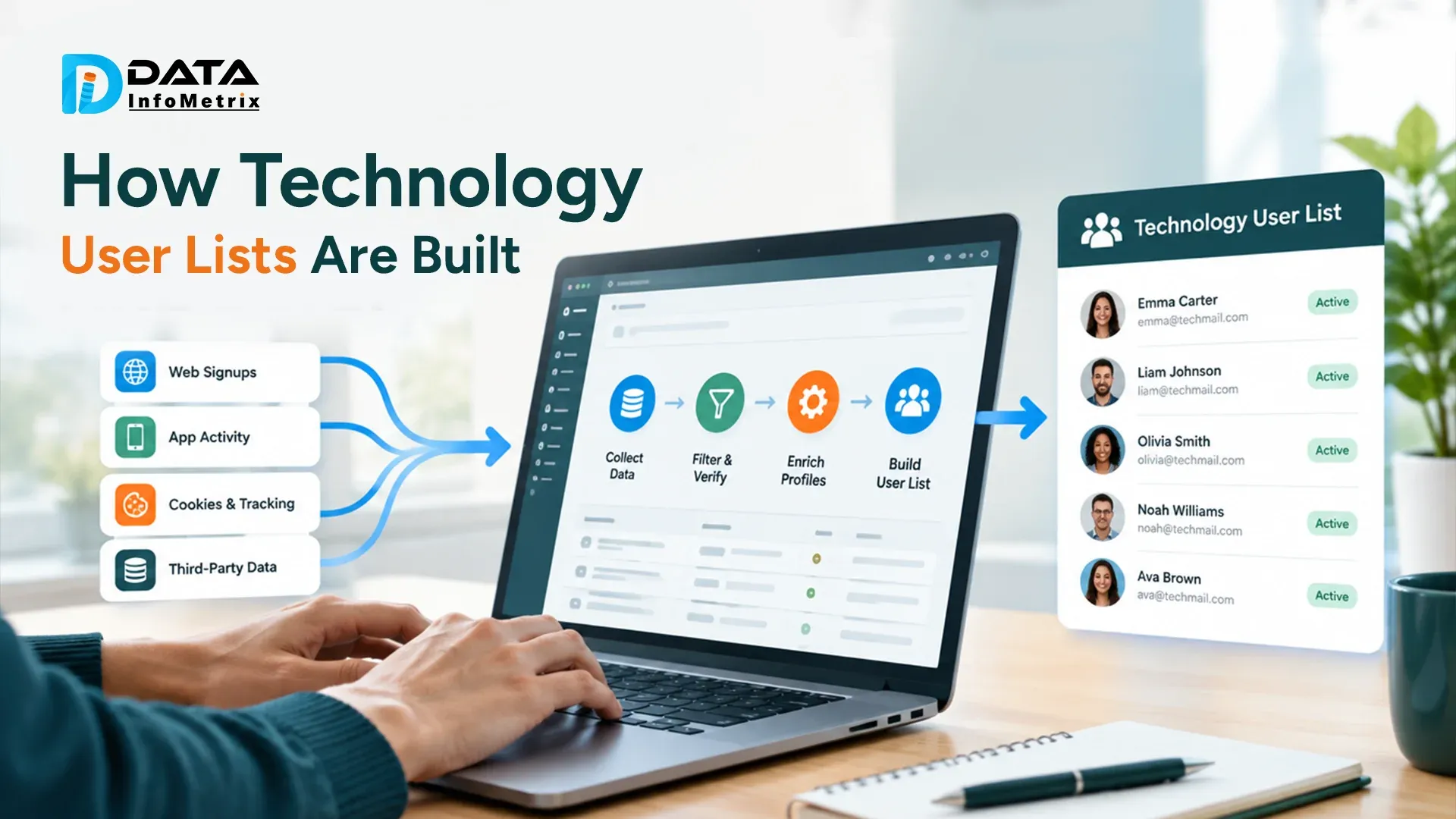
How Data InfoMetrix Builds and Delivers a Technology Users Email List
Learn how Data InfoMetrix builds technology users email lists using technographics, business signals, verification, and market intelligence.
Olivia Thomas · 4 min read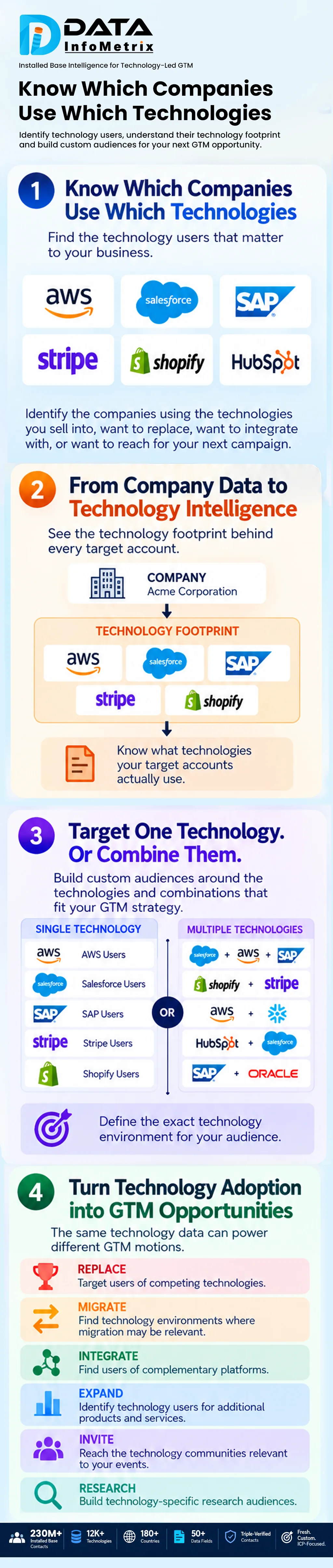
Know which Companies Uses Which Technologies
Know which companies use which technologies to target key B2B buyers. Access verified technographic data & contact lists. Claim your free sample today!
Olivia Thomas · 1 min read